
How to speed up or stop copper oxidation in Minecraft The Copper Age
Copper oxidation in Minecraft has evolved from a decorative curiosity into a complex environmental mechanic that now influences both aesthetics and gameplay systems. With The Copper Age update, oxidation affects a wide range of blocks and items - from building materials to redstone-linked devices and even the copper golem. The phenomenon introduces a layer of temporal realism: structures weather with age, tools lose their luster, and the player’s builds visually record the passage of time. Yet for all its beauty, the process remains governed by strict mathematical rules hidden beneath Minecraft’s procedural surface. To master oxidation is to understand how to bend randomness into predictability, turning slow chemical decay into deliberate design.
Control the rhythm of decay
At its core, copper oxidation in Minecraft operates through random ticks - background game events that simulate gradual changes like plant growth or leaf decay. Unlike the real world, rain and water do not accelerate this transformation, nor does sheltering a block prevent it. Instead, the key factor is proximity: copper blocks slow one another down when clustered too closely. If a block detects another copper piece within four blocks that is less oxidized, it suspends its own oxidation.
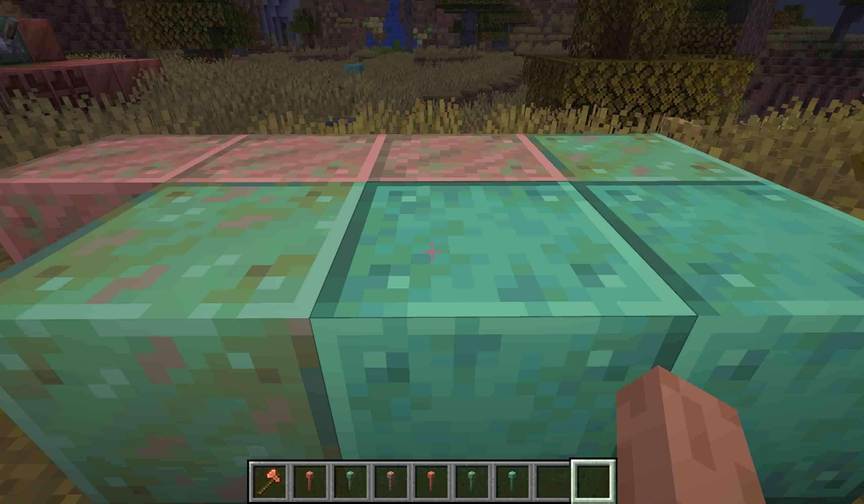
This system creates a collective behavior where oxidation spreads visually from edges or isolated blocks rather than randomly. Single blocks placed at least four spaces apart oxidize the fastest, unaffected by nearby penalties. In contrast, dense groups of copper can take hours or even days of in-game time to change color, as their mutual checks continually delay progress. On average, a single isolated copper block requires around an hour of real time to fully oxidize under normal tick rates. Builders who wish to accelerate the process can temporarily increase the game’s random tick speed through commands, but in standard play, structural arrangement remains the only legitimate accelerator.
Accelerate with structure and distance
To speed up oxidation naturally, spatial strategy is everything. The four-block separation rule forms the foundation: each copper block needs breathing room to evolve independently. When spaced correctly, the penalty check that links oxidation rates disappears, allowing each block to enter its “pre-oxidation” state freely. With no less-weathered blocks nearby, the probability of progression sharply increases, effectively making isolated or widely spaced copper the fastest to age.
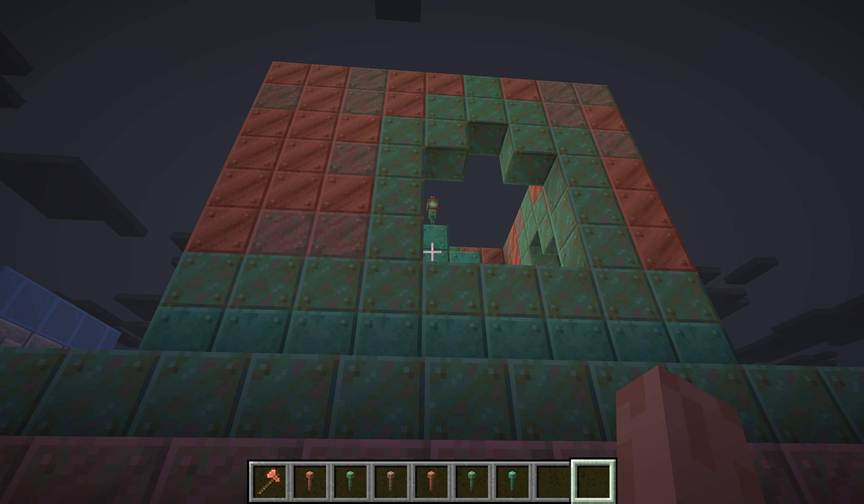
The process unfolds visually consistent with environmental logic: oxidation begins at exposed edges, corners, or sparsely populated areas, and then appears to “spread” inward - though in reality, each block changes independently. Builders can manipulate this illusion by placing oxidized blocks intentionally among newer ones to create controlled aging gradients. This design technique is particularly effective for roofs, statues, or mechanical constructs where the goal is to simulate slow weathering rather than uniform patina. In complex projects, alternating between spaced oxidation farms and compressed decorative builds yields the most efficient combination of speed and artistic flexibility.
Preserve the shine with wax
Waxing remains the definitive method for halting oxidation completely. Applying honeycomb to any copper block converts it into its waxed variant, locking its current color and texture indefinitely. This technique functions across all oxidation stages, from clean to fully oxidized, allowing players to freeze specific tones for architectural or artistic control. Waxing can be performed either directly by right-clicking with honeycomb or through crafting, which efficiently processes multiple blocks at once. Because honeycomb is a renewable resource, large-scale waxing operations are feasible for long-term builds.
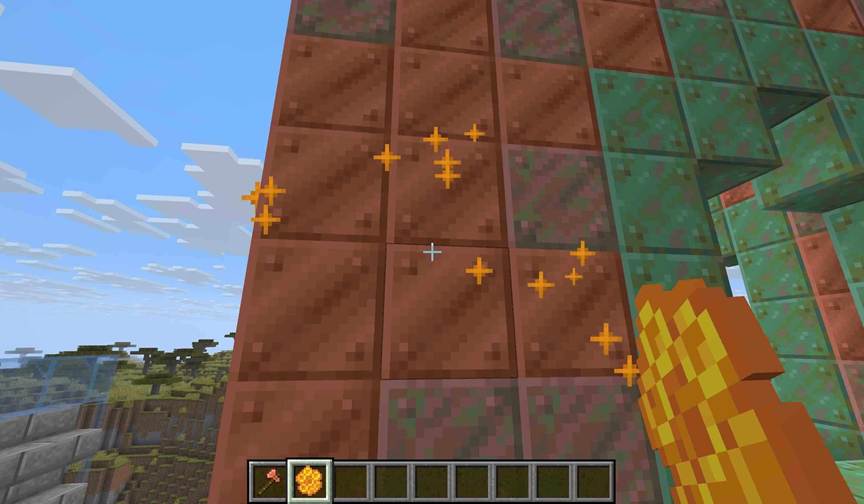
Precision management becomes especially valuable in hybrid builds that rely on contrast between oxidation levels. A player might preserve a central spire’s original shine while letting surrounding panels weather naturally, achieving the impression of maintenance or selective restoration. To reverse the process, an axe removes wax and restores oxidation activity, while repeated scraping gradually returns a block to its earlier states. This reversible control system enables dynamic adjustment even after construction - copper builds can evolve visually as projects expand or seasons change, offering rare adaptability among Minecraft’s material palette.
Reverse time with lightning and tools
While random ticks govern oxidation, lightning and manual intervention allow reversal. When lightning strikes a copper block, it immediately removes all oxidation from that block and can trigger a cascading deoxidation effect across nearby unwaxed copper pieces. In Java Edition, this chain reaction follows a randomized “walk” pattern, potentially affecting dozens of blocks within range. As a result, storms can unpredictably refresh entire structures, stripping patina and restoring copper’s original hue. Builders seeking to preserve oxidized aesthetics often protect large copper builds with lightning rods or nonconductive barriers to prevent accidental resets.
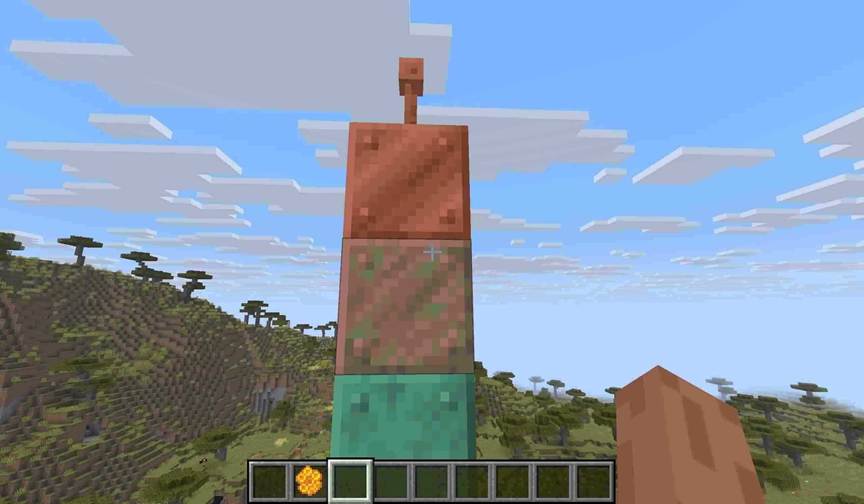
The axe provides the deliberate alternative to lightning’s chaos. Scraping a copper block removes one oxidation layer per swing, allowing precise restoration without damaging structure or layout. This mechanic not only supports aesthetic maintenance but also functions as a crafting step for “Wax Off” achievements, reinforcing copper’s dual role as both artistic medium and interactive system. Together, lightning and tools form a cyclical narrative of decay and renewal - the same block can oxidize, be struck, restored, and oxidize again, mirroring the environmental cycles of a living world.
Design with intention
Managing copper oxidation is ultimately about time, control, and storytelling. Builders who embrace natural progression can use oxidation to show age and atmosphere - from ancient ruins streaked with turquoise to modern laboratories gleaming with newly forged copper. Others prefer precision, using wax and lightning strategically to curate every shade and texture. The Copper Age update transforms this once-static block into an evolving material that bridges science and art, engineering and environment. Its mechanics demand patience but reward mastery, granting builders the ability to choreograph change itself.
Through understanding spacing, waxing, and environmental influence, players gain not only technical command over oxidation but also creative authorship over how their worlds evolve.