
How to prevent copper blocks from oxidizing in Minecraft The Copper Age Update
The Copper Age update transforms copper from a decorative curiosity into a dynamic building material with real-world physics. Unlike static blocks such as stone or iron, copper reacts to the passage of in-game time through oxidation - gradually shifting from bright orange to weathered teal. While this evolving patina adds realism and atmosphere to Minecraft builds, it also challenges players who wish to preserve copper’s original shine. Fortunately, the update introduces precise tools to prevent, reverse, or manipulate oxidation, offering full creative control over how copper ages in the world.
Use honeycomb to halt oxidation
Waxing is the definitive method to stop copper from oxidizing. Applying a honeycomb to any unwaxed copper block immediately locks it in its current visual and chemical state. This can be done either through crafting - combining the block and honeycomb on a table - or directly in the world by interacting with the block while holding the honeycomb. In both cases, a faint particle effect confirms that the surface is now sealed, preventing further exposure to Minecraft’s environmental tick system.
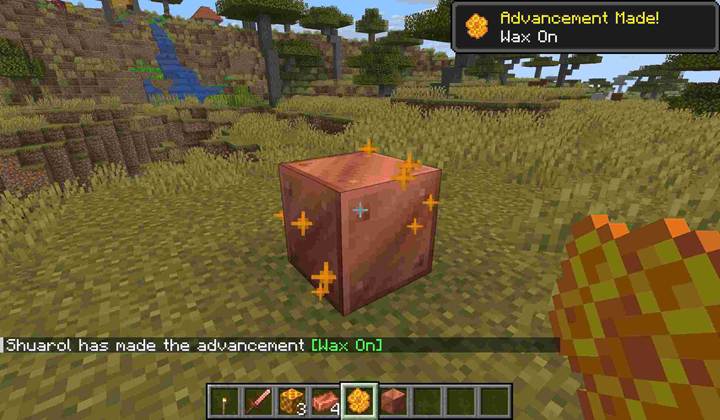
Once waxed, a copper block becomes inert to oxidation, regardless of surrounding conditions or nearby oxidized blocks. The process is completely reversible: using an axe removes wax first, then progressively strips away oxidation if present. This duality allows builders to fine-tune aesthetic aging, maintaining specific oxidation levels without the risk of further change. In large architectural projects, waxing not only stabilizes texture consistency but also simplifies long-term maintenance by freezing the block’s evolution indefinitely.
Understand how copper oxidation spreads
Copper oxidation in Minecraft is governed by random ticks, not weather exposure or biome type. Rain, humidity, or altitude have no effect; instead, the game calculates oxidation based purely on chance and proximity. Each unwaxed copper block has a 64⁄1125 probability during a random tick to enter a pre-oxidation state - roughly equivalent to a 5 percent chance per minute under normal tick rates.
Groups of copper blocks influence each other’s rates. If nearby blocks are less oxidized, they slow down the progression for all surrounding blocks. This phenomenon, known as group inhibition, means that oxidation typically starts at exposed corners or edges and spreads inward. Builders seeking uniform color control often space copper blocks at least four blocks apart to isolate them from collective aging patterns. Conversely, placing oxidized blocks near unoxidized ones can accelerate patina formation, allowing intentional asymmetry for realistic architectural weathering.
Reverse oxidation using axes and lightning
Even after copper has begun to oxidize, players retain the ability to restore its original shine. Striking an oxidized copper block with an axe removes oxidation in stages - from oxidized to weathered, from weathered to exposed, and finally back to its raw metallic state. The process is entirely manual and precise, offering an incremental way to correct unwanted aging without replacing materials. In gameplay terms, this mechanic balances copper’s natural decay with the player’s agency to reset or sculpt its appearance.
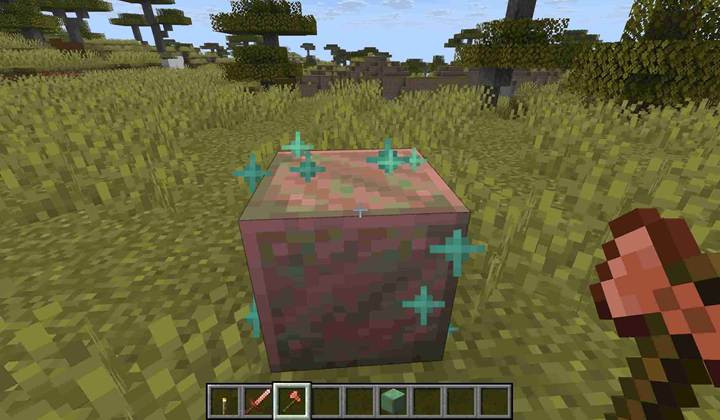
Lightning adds another layer of environmental control. When a lightning bolt strikes a copper block, it instantly removes all oxidation from the impacted block and may partially deoxidize others nearby within a three-block radius. In Java Edition, the effect follows a random walk algorithm that can cleanse up to forty surrounding blocks in a single event. Builders can exploit this by strategically placing lightning rods to trigger controlled deoxidation during storms, effectively creating natural restoration cycles that mimic metallurgical processes.
Apply waxing across all copper variants
The Copper Age update expands the number of waxable items, extending oxidation control beyond standard blocks. Players can now preserve copper chains, bars, lanterns, chests, trapdoors, grates, and even copper golem statues using the same honeycomb mechanism. Each of these structures follows identical oxidation stages - unoxidized, exposed, weathered, and oxidized - and responds to waxing and scraping consistently. This standardization simplifies design workflows, allowing large-scale copper builds to maintain visual integrity without constant upkeep.
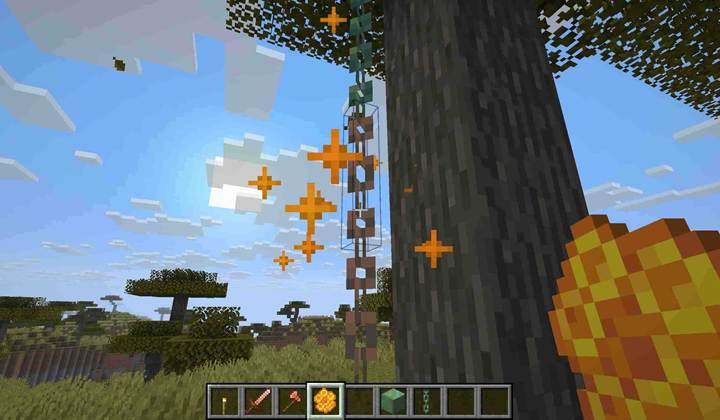
For builders pursuing thematic consistency, waxing also serves a compositional function. The deliberate contrast between waxed and unwaxed copper introduces color gradation that mirrors real-world architecture - from bright metallic roofs to aged statues. Moreover, because waxed blocks retain full compatibility with redstone and structural properties, players can preserve both aesthetics and functionality. The system’s flexibility reflects Mojang’s design philosophy for the Copper Age: realism that enhances creativity rather than constraining it.
Design with oxidation in mind
Preventing oxidation is as much an artistic choice as a technical one. Waxed copper allows precision, enabling modern, polished designs that resist environmental aging, while unwaxed copper introduces natural decay that tells a story of time and atmosphere. Many builders alternate between the two, freezing select sections and letting others evolve organically. The result is an architectural dialogue between permanence and transformation - a visual timeline etched across the surfaces of Minecraft worlds.
From a systems perspective, the ability to prevent, reverse, and accelerate oxidation elevates copper into one of Minecraft’s most dynamic materials. Its behavior integrates chemical realism with creative adaptability, allowing players to sculpt not only structures but also their rate of aging.