
How to get the copper chest in Minecraft
The Copper Age update redefines Minecraft’s resource economy by expanding copper’s purpose far beyond decoration. Among its most practical additions is the copper chest - a metallic counterpart to the classic wooden storage block that bridges early-game simplicity with late-game automation. It functions as a regular chest in every fundamental way, yet it becomes a cornerstone of the game’s new sorting ecosystem when paired with the copper golem. This combination introduces automation to survival gameplay without relying on complex redstone logic, replacing mechanical systems with living agents.
Build your foundation
Acquiring a copper chest can be done through two distinct methods: summoning a copper golem or crafting. The summoning route is a unique blend of old and new mechanics. Placing a carved pumpkin or jack-o’-lantern atop a copper block instantly brings a copper golem to life while converting the base block into a copper chest. The chest inherits the oxidation state of the copper block used in the process, allowing players to determine its appearance based on how weathered the material was before summoning. A fresh copper block produces a gleaming orange chest, while an oxidized one yields the characteristic teal hue of aged copper.
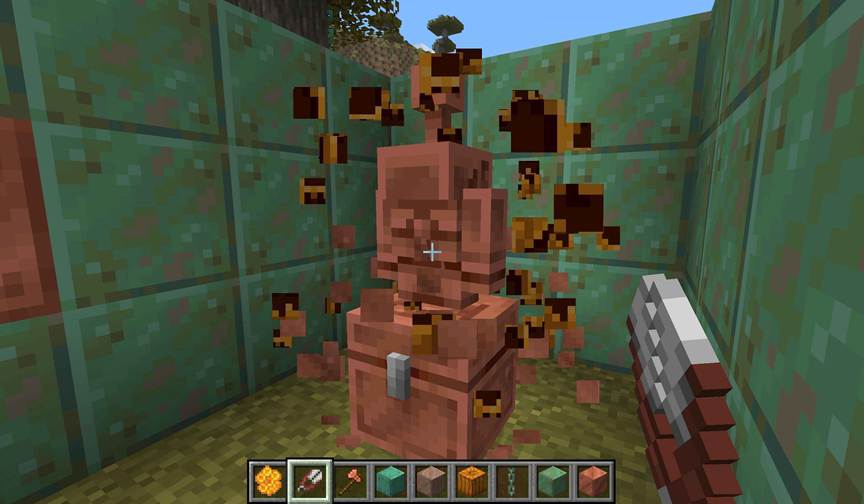
Alternatively, crafting provides a predictable path. Surrounding a standard wooden chest with eight copper ingots in the crafting grid produces a copper chest identical in storage capacity and functionality to its summoned version. This crafted variant offers 24 slots in single form or 54 when doubled, matching the inventory size of standard chests. The copper chest can be mined safely with a stone pickaxe or stronger tool, but using a wooden or gold pickaxe will destroy it and drop no items. This design ensures copper remains consistent with Minecraft’s progression logic, maintaining material hierarchy while rewarding resource investment.
Manage oxidation and waxing
Like all copper-based materials, copper chests oxidize over time, transitioning through exposed, weathered, and fully oxidized states. This transformation is purely visual - it does not affect capacity, function, or interaction speed. However, it can alter the aesthetic harmony of a storage room, particularly when multiple oxidation stages coexist. Players who wish to freeze a chest’s appearance can apply honeycomb directly to it, either through manual interaction or via the crafting grid. This process “waxes” the chest, preventing any further oxidation.
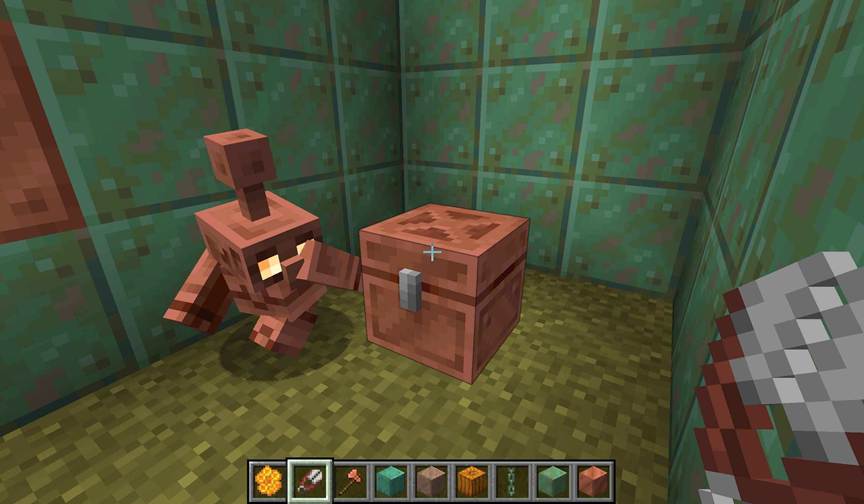
To reverse oxidation or remove wax, players can use an axe. The first strike removes the wax coating; subsequent strikes reduce oxidation one stage at a time. The tactile feedback of this mechanic reinforces copper’s material realism, making maintenance a small but meaningful act of craftsmanship. Lightning also interacts with copper chests indirectly - if a lightning rod is nearby, a strike can deoxidize multiple copper components in the area, including chests, restoring them to their original brightness. These layered systems give builders full control over both the look and the lifecycle of their copper infrastructure.
Use copper golems effectively
The copper chest’s defining feature is its integration with copper golems. When placed near these new entities, it becomes the starting point for an autonomous sorting network. A copper golem scans its environment for copper chests within a radius of roughly 32 blocks horizontally and eight vertically. If it detects stored items, it retrieves up to sixteen units of a single item type and seeks an eligible target chest - either an empty chest or one already containing that same item. Once found, it deposits the load and repeats the process.
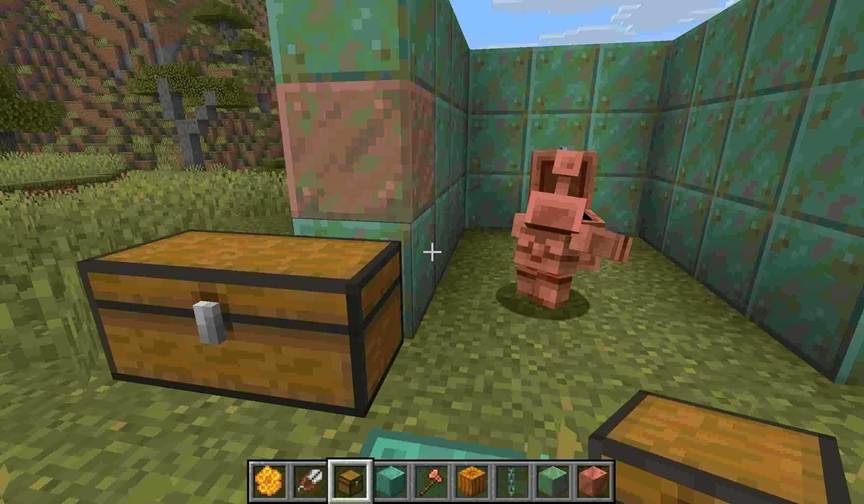
Each copper golem can remember up to ten copper chests per search cycle. If it fails to locate matching inventories, it briefly idles before resetting its memory and resuming the loop. This behavior mimics a lightweight logistics algorithm, functioning without player commands or redstone circuitry. The efficiency of this system depends heavily on proximity and accessibility: chests blocked by solid full blocks above cannot be opened by either players or golems, though transparent or partial blocks such as stairs or glass panes allow interaction. Proper spatial design thus becomes essential for uninterrupted automation.
Expand and optimize your network
The copper chest is fully compatible with traditional storage mechanics, including hoppers, droppers, and comparators. Items can be inserted from above, extracted from below, or detected for redstone output, ensuring hybrid designs that merge copper golem automation with mechanical infrastructure. Players can construct layered storage arrays where copper golems handle sorting logic while hoppers manage bulk throughput to smelters, furnaces, or item elevators. This interoperability makes copper chests a bridge between organic and engineered systems, blurring the distinction between mob-based and redstone-based automation.
The chest’s oxidation also introduces a new form of visual signaling. Some builders intentionally use different oxidation stages to mark categories of items - for example, unoxidized chests for raw materials, exposed for crafted goods, and oxidized for rare items or endgame loot. When waxed strategically, this approach creates a permanent, color-coded storage taxonomy that requires no external labeling. As a result, the copper chest becomes not just a container but a design element, integrating functionality with aesthetics in a way wooden chests never could.
Preserve your system for the long game
Waxed copper chests represent permanence, but unwaxed versions tell a story. Over extended playtime, a base filled with oxidized chests and weathered golems conveys age and history - an unspoken timeline of progress written in color and corrosion. For builders who value realism or narrative design, the passage of oxidation becomes part of the world’s identity. Yet for players who prefer pristine order, periodic waxing or controlled deoxidation ensures that every chest remains visually unified.
It rewards attention to detail, balances simplicity with automation, and transforms a once-overlooked resource into an integral pillar of survival engineering. In the evolving ecosystem of the Copper Age, the copper chest is more than a container - it is a symbol of progression, design intelligence, and the quiet poetry of mechanical life.