
How to Drive and Maintain Vehicles in Project Zomboid
Vehicles were added in Build 39 and are the main way to traverse Knox Country, letting you haul loot, run down zeds and turn a wreck into a mobile safehouse. The wiki notes vehicle condition "may vary, ranging from pristine to useless wreckage," and they typically turn up "on parking lots, driveways, along bridges or major highways and as a part of a randomized story." One honest caveat up front: the source page itself flags that it "was last updated for an older version of the current build (42.16.0)," while the current stable version is 42.20.4, so some specifics below may have shifted since. This guide covers what to know before you get behind the wheel — vehicle types, how to read a vehicle's stats, the noise system that decides how many zombies you attract, and the refuel/tow/key basics that keep a car running day to day.
Vehicle Types, Models and the Magazines You Need
The wiki states plainly: "Vehicles have three distinct types, standard, heavy-duty and sports." Each type spawns in its own kind of area — heavy-duty near industrial buildings, sports cars in richer neighborhoods — and each requires its own recipe magazine before you can add, remove or repair type-specific parts, unless you're a mechanic or have the vehicle knowledge trait:
- Standard, learned from Magazine: Laines Standard Auto Manual
- Heavy-Duty, learned from Magazine: Laines Commercial Auto Manual
- Sports, learned from Magazine: Laines Performance Auto Manual
One trap worth knowing: even with the vehicle knowledge trait, the wiki notes "players with vehicle knowledge trait still need the Magazine: Laines Performance Auto Manual magazine for sports vehicles" — that one magazine isn't skipped by the trait.
The source states "there are currently 14 different vehicle models available, as well as three types of trailers." Its own vehicle table actually lists 18 named entries, but that's consistent with the 14-model count once you account for variants — the wiki explicitly calls out "multiple variants of some vehicles, such as the Fossoil Chevalier D6, and the Police Chevalier Nyala," and its trailer table lists five named entries (Horse trailer, Livestock Trailer, Trailer, Trailer (advert), Trailer (cover)) under the stated three trailer types. Vehicles tied to a profession also spawn profession-relevant loot inside — the wiki's own example: "an ambulance may contain medical supplies."
Reading Vehicle Stats: Weight, Power, Speed and Seats
The wiki's Legend defines what each stat controls before the table itself: Weight is "base mass of the vehicle. Affects acceleration and collisions. Heavier vehicles push through obstacles better but accelerate and brake slower." Engine power is "raw power output of the engine, determining how fast the vehicle can accelerate. Higher means faster pickup and stronger towing ability." Top speed is "base top speed," though the vehicle "may exceed this as it's affected by other factors, such as gear ratio, engine RPM type, engine force and terrain."
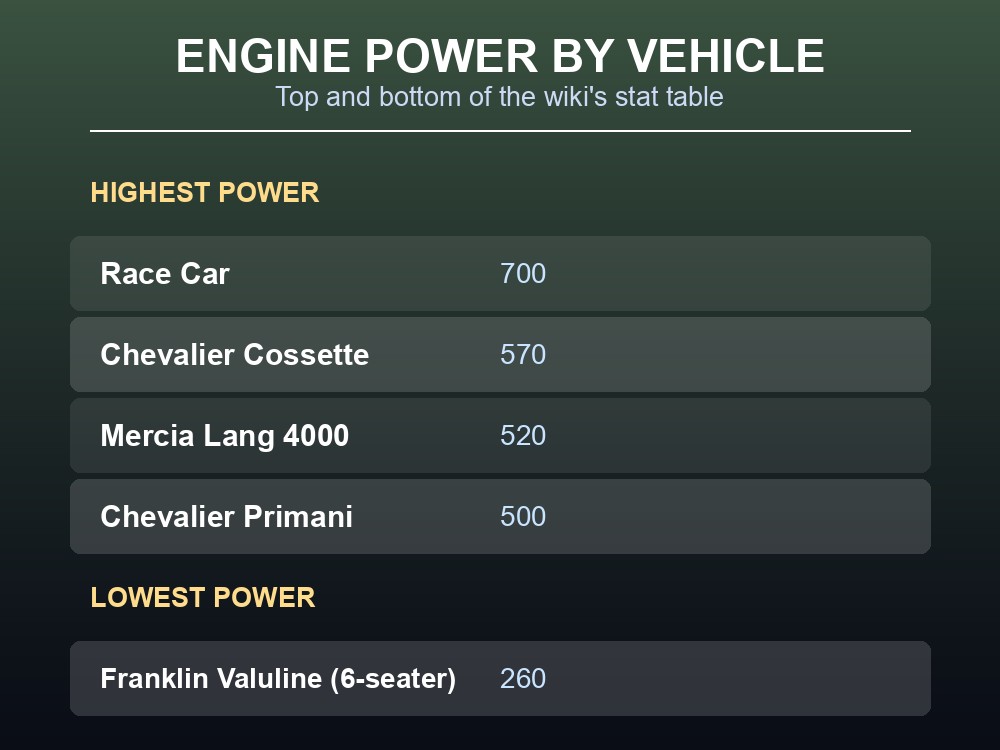
Reading the per-vehicle rows in that same Legend order (Weight, Engine power, Engine quality, Engine loudness, Top speed, and onward to Seats), the Race Car tops engine power at 700, with a 800 weight, a 120 top speed and 4 seats. The Franklin Valuline (6-seater) sits at the other end for power, at 260. That's 700 ÷ 260 ≈ 2.7 times more engine power on the Race Car. On top speed, the Race Car and Chevalier Cossette both list 120, exactly double the Dash Bulldriver's 60 (120 ÷ 60 = 2). Undocumented: the source's raw table doesn't repeat its column headers per row, so the mapping above follows the order the wiki's own Legend section states immediately above the table — it isn't a separately labeled header on every row.
Noise, Mufflers and Zombie Aggro
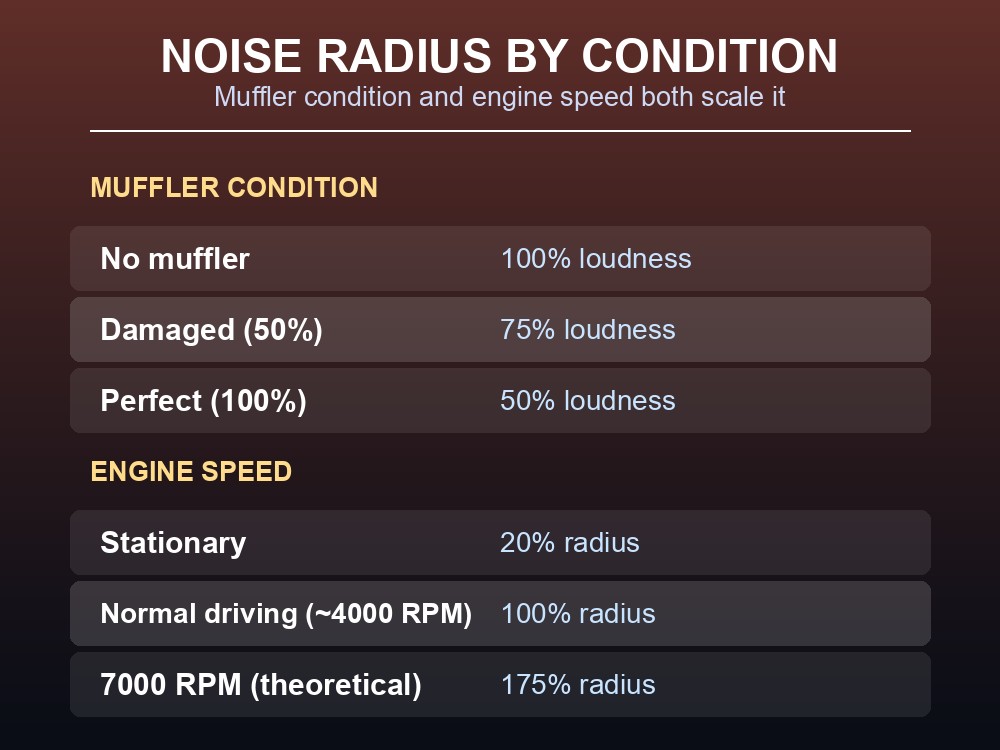
Engine noise is the main maintenance-relevant risk of driving. The muffler modifier scales straight off condition: "No muffler: Full loudness," "Damaged muffler (50%): 75% loudness," "Perfect muffler (100%): 50% loudness" — going from no muffler to a perfect one exactly halves the noise (100% down to 50%). Speed matters too: "Stationary with motor on: 20% radius," "Normal driving around 4000 RPM: 100% radius," and "Driving at 7000 RPM (theoretically): 175% radius" — normal driving alone is 5 times louder than sitting still with the engine on (100% ÷ 20% = 5).
Underneath that, the game checks four separate sounds every second the engine runs, each with its own chance and radius formula: Sound 4 every second at volume ÷ 6, Sound 3 at a 1-in-10 chance at volume ÷ 4, Sound 2 at 1-in-30 at volume ÷ 2, and Sound 1 at 1-in-120 at full volume. Net result, per the wiki: "a vehicle will attract zombies in a wide area every two minutes on average, but this is not consistent." It's also worth knowing that "vehicle noises, though loud, are not as attractive to zombies as some quieter noises" — the wiki's example is that "a zombie will often prefer to chase a shout or a sneeze over an engine."
Refueling, Towing, Car Keys and Hot-Wiring
To refuel, right-click the vehicle and select refuel — you can pour from "a container with gas, gas can, or at a gas pump," and the siphon option only appears "if the player has an empty gas can." If a gas pump won't offer the refuel option, check that the gas cap is on the same side as the pump; the fuel indicator shows the cap side with an arrow.
Towing works by driving a second vehicle to the front or rear of the one you're towing, walking between them, opening the radial menu (V) and selecting the plus sign — no extra equipment required, but tire pressure on both vehicles affects tow speed, and traits swing it hard: Sunday driver "negatively impact[s] the player's ability to tow vehicles greatly" because it cuts acceleration, while speed demon "positively impact[s] the player's ability to tow vehicles greatly" for the same reason. Weight-to-power ratio also plays a role, but the wiki calls the practical difference "fairly small" even when the towed vehicle is stripped down.
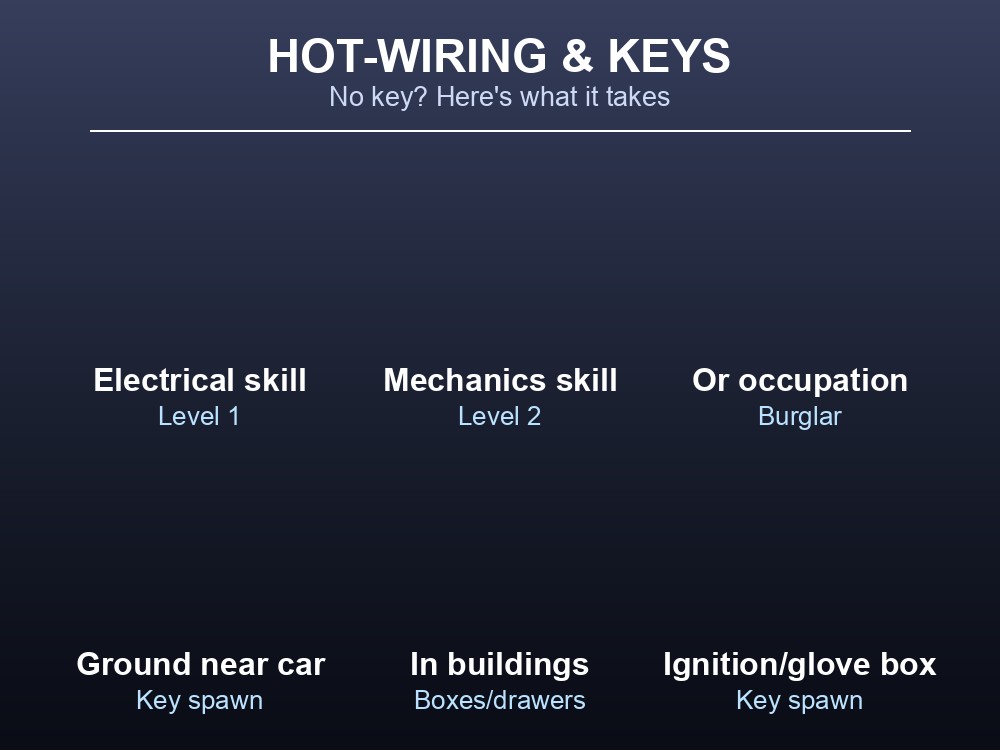
Car keys work with only one vehicle each and let you start the engine and open doors/trunk from outside. They spawn on the ground near the car, inside nearby buildings ("in boxes or drawers"), inside the vehicle itself (ignition or glove box), or — randomly — "on the body of the nearest killed zombie." Without a key, hot-wiring needs Electrical level 1 and Mechanics level 2, or the Burglar occupation: get into the driver's seat, open the radial menu, and pick "Hotwire Engine" in place of "Start Engine" (the normal ignition click or pressing W won't work without a key). A failed attempt "doesn't break the car or the player's tools" but can make noise, and per the wiki, "cars in better shape are trickier to hot-wire." In multiplayer, remember any player can drive a car once it's hot-wired.
Practical tips
- Fit or repair a muffler before a loot run — a perfect muffler halves your noise radius compared to none at all.
- Keep the engine near idle in tight spots; normal driving alone is five times louder than sitting still with the motor running.
- Check the fuel-indicator arrow before assuming a broken pump — it's often just the wrong side of the car.
- Grab the matching auto manual for whichever type (standard/heavy-duty/sports) you plan to repair — the vehicle knowledge trait still doesn't cover the sports manual.
Running your own Project Zomboid server
Vehicle wrecks, gas station stock and every car you've patched together only stay put if the world keeps running. On a dedicated Project Zomboid server, your garage of hot-wired heavy-duty vans and salvaged sports cars is exactly where you left it between sessions, with automatic backups protecting the build before a bad crash or a muffler-less loot run gone loud. Get your own Project Zomboid server running in minutes at gamever.io and save on your first month with promo code WELCOME.
Conclusion
Driving in Project Zomboid comes down to four things the wiki documents clearly: pick the right type and magazine (standard, heavy-duty or sports), read a vehicle's stats in the order its own Legend defines them, manage noise through muffler condition and engine speed since normal driving is five times louder than idling, and keep spare keys or hot-wiring skills in reserve since keys only work per-vehicle. Detailed part-by-part repair procedures live on the wiki's separate Mechanics page and aren't covered by this source — if you need repair specifics, that's the page to check next.
Ready to keep your world running while you're off exploring? Spin up your own Project Zomboid server at gamever.io today.