
How to Deal With Hordes in Project Zomboid
Project Zomboid's zombies (also called "zed", "infected" and "dead" in-game) are, per the wiki, "the player's main antagonists" who "roam the landscape in the thousands." Most of the time they're a manageable trickle. The problem is the horde: a mass of zombies following a single "horde leader," which the wiki flags outright as "the most dangerous, and are best avoided at any stage of the game." One caveat worth stating up front, because the source states it too: this page "was last updated for an older version (41.78.19)" against a current stable of 42.20.4, so treat specific numbers below as subject to change with patches.
Why Hordes Migrate — And How Not to Trigger One
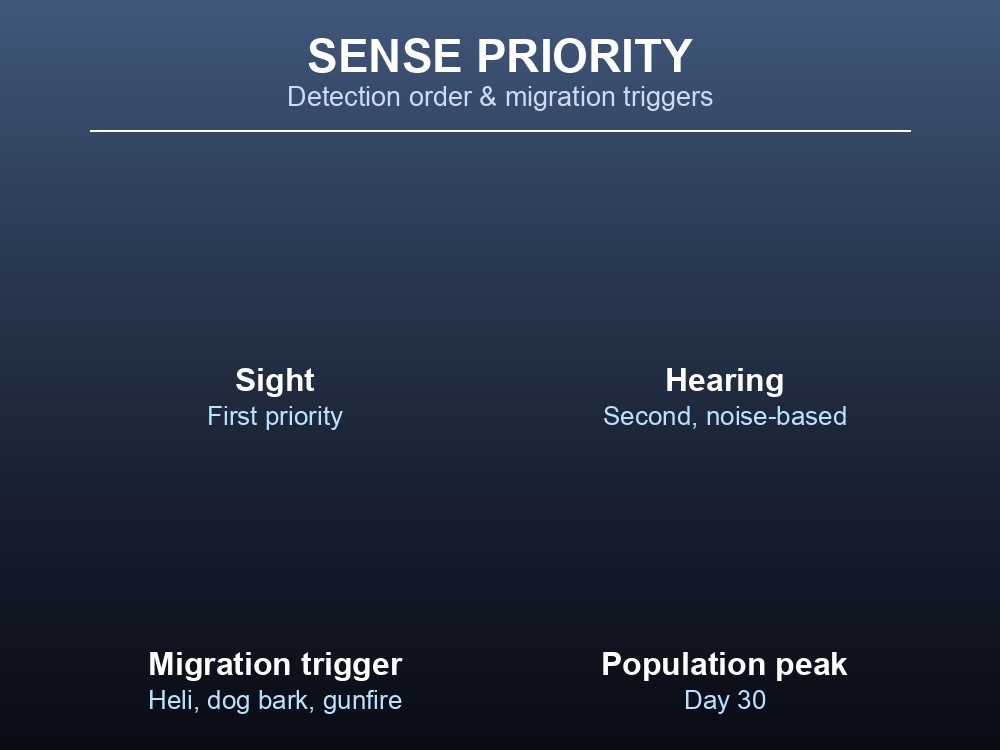
Population grows gradually: numbers "will increase and hit its peak after 30 days have passed," with urban areas and specific settlements like Louisville running higher than rural ones from the start. On top of that baseline, "at irregular intervals, events outside the player's control will cause zombies to migrate en-masse" — the wiki's own examples are "a helicopter might fly overhead, a dog may bark, or gunshots may be fired in the distance by an unseen survivor." These metagame events exist for "redistributing the zombie hordes over the map to balance gameplay over long periods of time."
The warning that matters most is a direct quote: "Zombies take the most direct route available to them to reach the noise source, with no concern as to whether this happens to be through the player's shelter." A migrating horde will walk through your base wall if that's the straight line to the noise, not around it.
Detection follows a strict order: "the sight of prey attracts them first and foremost. With no human flesh in sight, noise is the next priority, regardless of whether it is man-made or not (e.g., thunder)." Running vehicles, radios and gunfire are things zombies are "especially drawn to." The source gives no exact sight/hearing range in tiles or meters, and no specific horde-size number — those base values are undocumented here, and Custom Sandbox can change them anyway.
Injury Risk: Bites, Scratches and Lacerations
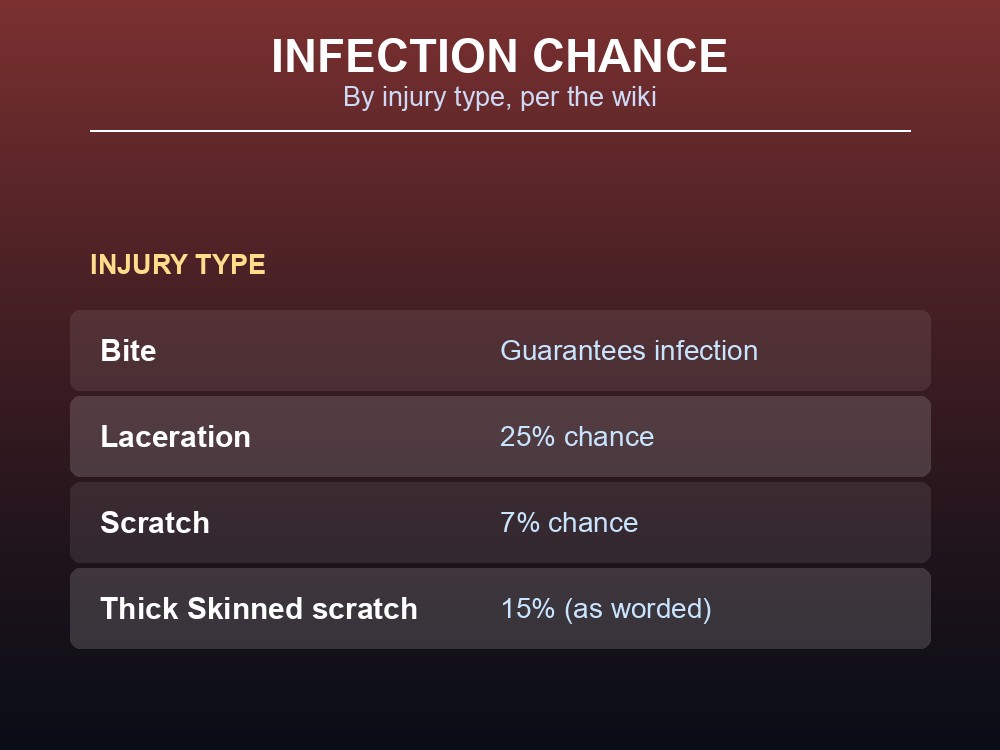
Zombie attacks fall into three named categories: "bites, scratches and lacerations." Only one is certain: "Bites are the gravest and inevitably lead to the death and zombification of the subject." The other two carry stated odds — "a chance of contracting the infection (7% for scratches, 25% for lacerations)." A laceration is over three times likelier to infect than a scratch (25 ÷ 7 ≈ 3.6), so damage sources prone to lacerations (broken glass, smashed windows) are meaningfully riskier.
The wiki also notes, quoted as written since its scope isn't fully explained: "If the character has the thick skinned trait, they have a 15% chance of being scratched. There is always a 25% chance of being bitten." Whether 15% is a reduced rate versus a baseline without Thick Skinned is undocumented — treat it as a direct quote, not a confirmed breakdown.
Positioning reduces exposure to all three. "If a zombie does manage to sneak up on a survivor, they have a higher chance of injuring them if the attack is from the rear." A downed zombie can be neutralized for free: "If a survivor or another zombie stands on a downed zombie or a vehicle is parked on-top, the zombie will be rendered unable to stand up." And a fence line under a horde isn't permanent — "the fence will take damage and eventually collapse if even more vault it."
Crawlers and Sprinters: Two Zombies That Break the Rules
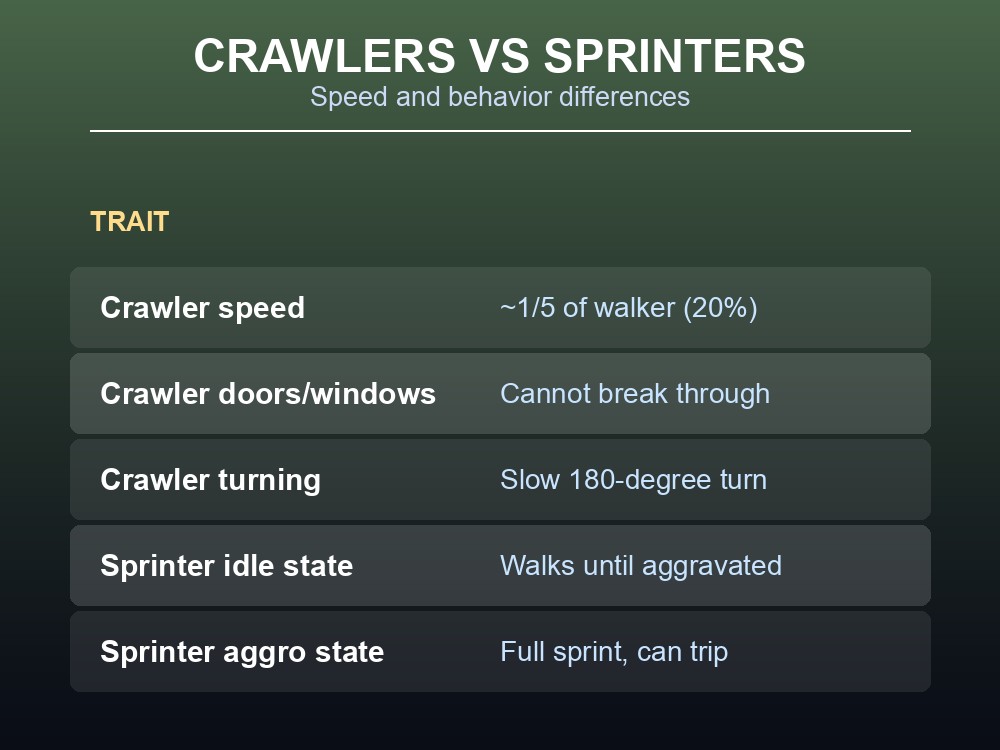
Crawlers move on their stomachs after being knocked down or spawning "playing dead." The wiki's comparison: "This type of zombie moves extremely slowly, at about a fifth of the speed the standing zombie may move at." 1 ÷ 5 = 20%, so a crawler covers roughly a fifth of the ground a standing zombie does in the same time — why it "will usually straggle behind and separate from the rest of the horde." Crawlers have real limits: one "is NOT capable of attempting to destroy a structure's door or window," can't go over fences (they attack the fence instead), and "has to push its entire body 180 degrees to turn around" — a survivor can exploit that by "going behind the rotating zombie and finishing it off quickly," but only "in a one-on-one situation."
Sprinters are different, and per the wiki appear "in the Extinction game mode" or via "Custom Sandbox settings or the Studio challenge map" — not default behavior. "Sprinters only walk when they're idle; once aggravated, they can easily catch up to a walking survivor." They're not invulnerable, though: "Sprinting zombies will occasionally trip and fall, creating an opportunity to escape or kill them while they're down." A fence helps here too: "Having a fence between the player and a sprinter could save their lives, as it will provide an opportunity to kill the zombie while they get up from the animation."
Stand on a downed zombie (or park a vehicle on it) to stop it getting back up. Don't hold a fence line against a whole horde alone — enough zombies vaulting it will collapse it. Flank a crawler from behind while it's mid-turn, one-on-one only. If a sprinter is chasing you, put a fence between you and it before it closes the gap.
Running your own Project Zomboid server
Hordes hit differently on a dedicated server, where sandbox settings, population, and migration events are shared across everyone logged in rather than tuned around a single save. A private Project Zomboid server lets your group set horde difficulty, respawn rate, and Sandbox zombie options once, then plan base defenses — fence lines, chokepoints, door reinforcement — around settings everyone agreed on instead of whatever a public server rolled. Get your own Project Zomboid server running in minutes, and use code WELCOME for a discount on your first month.
Conclusion
The wiki's own framing is the best summary: zombie hordes are "the most dangerous" state in Project Zomboid, not because any single zombie is strong, but because sight-then-sound detection, metagame migration events, and vault-driven fence damage compound once enough zombies move as one group. Bites are a guaranteed infection; scratches and lacerations carry lower but real odds (7% and 25%); crawlers and sprinters both break the standard-zombie rules enough to need their own tactics — slow but door-safe for crawlers, fast but trippable for sprinters. None of that changes the wiki's central point: avoid triggering a horde in the first place, and if one's already moving toward noise you made, get behind cover before it arrives.