
How to create and pose a copper golem statue in Minecraft The Copper Age
Among the most distinctive additions in The Copper Age update, the copper golem statue bridges Minecraft’s engineering systems with its growing focus on environmental storytelling. Once a living utility mob that organizes items and interacts with chests, the copper golem eventually succumbs to time, transforming into a static yet expressive monument of oxidation. What begins as a functional companion becomes an artifact - a block that embodies the world’s passage of time and the player’s control over it. The copper golem statue is more than an aesthetic collectible; it is a dynamic, data-rich entity that reacts to tools, redstone, and weather, adding both narrative and mechanical depth to any build.
Build your copper golem
Creating a copper golem begins with the same logic that has guided golem construction since the earliest iron designs: form, material, and activation. Players construct a golem by placing a block of copper - at any oxidation stage - and topping it with a carved pumpkin or jack o’lantern. The resulting creature inherits the oxidation state of the block beneath it, ensuring full aesthetic continuity within themed builds. A waxed copper block produces a waxed copper golem, while an unwaxed block results in a golem that will continue to age naturally. Once summoned, the golem operates autonomously, sorting items through copper chests, wandering across its detection radius, and occasionally interacting with levers or doors.
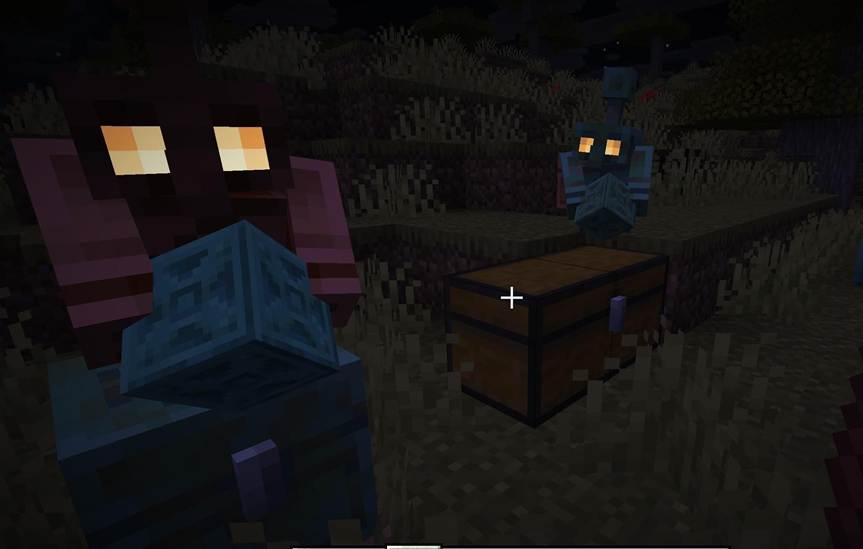
Like all copper entities, the golem oxidizes over time, transitioning from clean to exposed, weathered, and finally oxidized. The rate of this transformation depends solely on in-game random ticks, unaffected by rain, temperature, or light. Waxing halts oxidation completely, while scraping with an axe restores earlier stages. When a fully oxidized golem remains unwaxed, it no longer functions as a mob; within seconds, it solidifies into a copper golem statue, preserving its last pose and oxidation state as a permanent block.
Transform function into form
Once petrified, the copper golem statue becomes a hybrid between a decorative element and a technical component. It can be mined, placed, and repositioned like any other block, though using a pickaxe ensures faster recovery and drop retention. Statues retain their pose when broken, allowing precise replication across large-scale structures such as galleries, plazas, or memorials. The oxidation state also persists through mining, meaning that statues can serve as part of a color-coded system - from polished orange to deep turquoise - that represents time or environmental variation within a build.
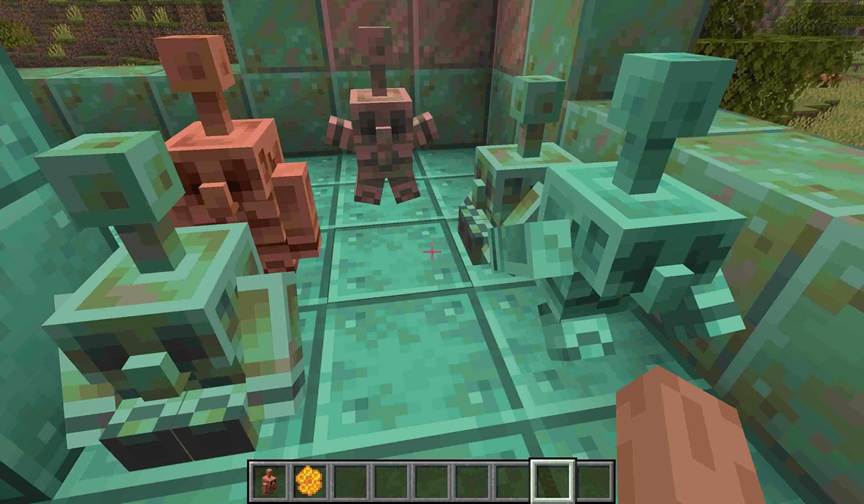
Each statue can occupy one of four poses: standing, sitting, running, or star - the latter with arms and legs extended dramatically outward. Players cycle through poses by interacting directly with the statue, observing distinct visual postures designed for both functional and narrative use. The system requires an empty hand in Bedrock Edition to prevent accidental item placement. Because poses are persistent, they can be used to convey motion or emotion in architectural storytelling - one statue saluting, another mid-stride, a third collapsed as if frozen mid-task. This intentionality transforms the once-mechanical golem into a tool of artistic direction, its immobility paradoxically enabling expression.
Preserve or revive your creation
Copper golem statues follow the same oxidation and preservation mechanics as all copper-based materials, giving players full environmental control. Unwaxed statues will gradually develop patina, while applying honeycomb locks their color indefinitely. Builders seeking to maintain a curated patina distribution can alternate between waxed and unwaxed variants, freezing some statues while allowing others to evolve naturally. Lightning strikes and axes serve as restoration tools, capable of stripping oxidation or, in the case of fully restored statues, reanimating them back into living copper golems. The process requires precision: scraping wax removes protection, further strikes remove oxidation, and a final strike on an unoxidized statue revives it into an active entity once again.
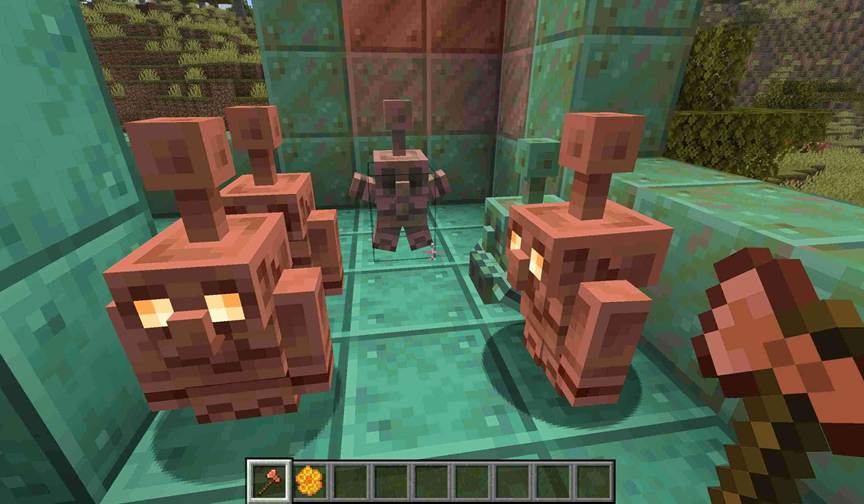
This reversible system gives copper golems and statues a cyclical identity - creation, oxidation, petrification, and renewal. Builders can integrate this loop into world design, using it as a metaphor for maintenance, decay, or rebirth. A ruined workshop filled with oxidized statues can later be restored to motion through careful scraping, creating an emergent narrative of technological revival. Similarly, waxing allows preservation of specific moments in time, freezing a pose or color as part of a curated historical tableau. The balance between control and entropy forms one of The Copper Age’s central themes: the player’s ability to shape, halt, or reverse the effects of time itself.
Activate poses with redstone
Beyond decoration, copper golem statues interact with Minecraft’s redstone circuitry through comparator outputs. Each pose emits a distinct signal strength: one for standing, two for sitting, three for running, and four for the star pose. This transforms statues into functional signal sources that can represent coded states in automation systems. Builders can design puzzles, security systems, or secret doors that respond to pose changes, effectively converting aesthetic figures into programmable components. Because pose cycling is manual, statues can also serve as hidden input devices within adventure maps or custom base mechanisms.
The redstone compatibility demonstrates the Copper Age’s broader philosophy of merging ornamentation with interactivity. Statues act simultaneously as visual centerpieces and logic gates, maintaining design coherence across both artistic and mechanical layers. Their integration with conductors and comparators extends copper’s role in redstone engineering beyond passive material, transforming it into an intelligent design element that stores data through posture. This fusion of sculpture and circuitry represents one of Minecraft’s most sophisticated mechanical evolutions - where the act of posing becomes a form of programming.
Design a legacy of motion and memory
The copper golem statue stands as a synthesis of two opposing design ideals: function and permanence. It is both machine and monument, both servant and symbol. Within the Copper Age, this duality enriches Minecraft’s creative language, allowing players to treat automation not only as efficiency but as storytelling. Rows of oxidized statues can line the halls of ancient factories, waxed figures can guard modern vaults, and reanimated golems can rise again to serve their creators. Every state - active or still, polished or green - tells a story about time, intention, and control.
By mastering the process of creation, posing, and preservation, players unlock a new vocabulary of design rooted in transformation. The copper golem statue, like the metal it embodies, reminds builders that even in a world of blocks and code, time leaves traces - and those traces can become art.