
How Temperature and Weather Work in 7 Days to Die
7 Days to Die tracks two separate temperature numbers, and only one of them can actually hurt you. The wiki is direct about the split: "Temperature consists of 2 components: Ambient temperature refers to the actual temperature of the environment around the character. Feels Like temperature refers to the effective temperature of the character." Status effects — Cold, Freezing, Hot, Sweltering — are triggered only by Feels Like, never by the raw Ambient number on your HUD. This guide covers both numbers, the exact °F thresholds where each status effect kicks in, and every documented Cold Resist / Heat Resist source. One honesty note first: the source page carries its own version warning, quoted verbatim — "This article may contain outdated information that is inaccurate for the current version ( Version 3.2 ). It was last updated for version ( Version 3.0 )." Treat the numbers below as last-documented, not confirmed for the current patch.
Ambient Temperature, Weather, and Feels Like Temperature
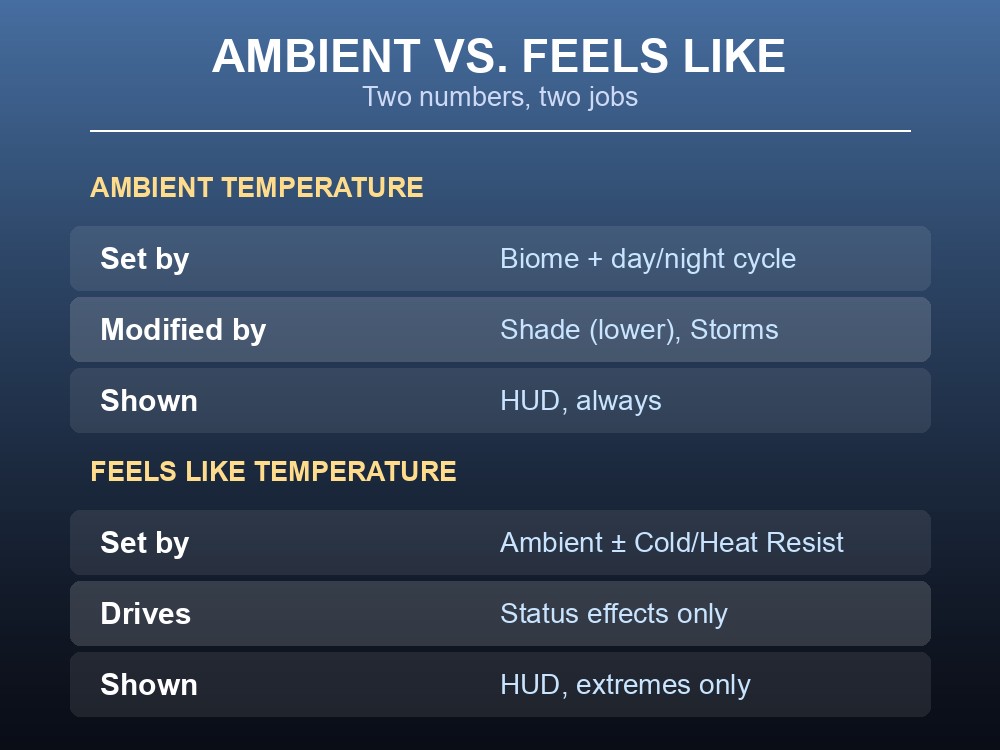
Ambient temperature is environmental: "Each biome has its own temperature patterns which fluctuate throughout the day and night cycles." Two things push it further — "Shade decreases Ambient temperature," and "Weather, especially Storms, will also periodically influence the Ambient temperature, separate from the above effects." That's the extent of what's documented about weather's effect — no specific storm-degree shift, rain-chance percentage, or storm duration is given, so the size of a storm's swing is undocumented even though the direction is confirmed. Ambient is always visible: "The Ambient temperature is displayed on the HUD next to the day and time."
Feels Like temperature (core temperature) is what actually matters: "the effective temperature experienced by the character, taking into account the Ambient temperature and modified by the character's Cold Resist and Heat Resist stats." Critically, "Characters experience various temperature-related Status Effects based only on their Feels Like temperature, regardless of the surrounding Ambient temperature" — a freezing Ambient reading isn't automatically dangerous if your Cold Resist is covering the gap. It's also mostly hidden: "Feels Like temperature can only be seen at extreme temperatures, displayed when the effect is shown." The page's infobox carried no additional structured data beyond the article text — undocumented.
Cold Resist Is What Keeps You Out of the Freezing Zone
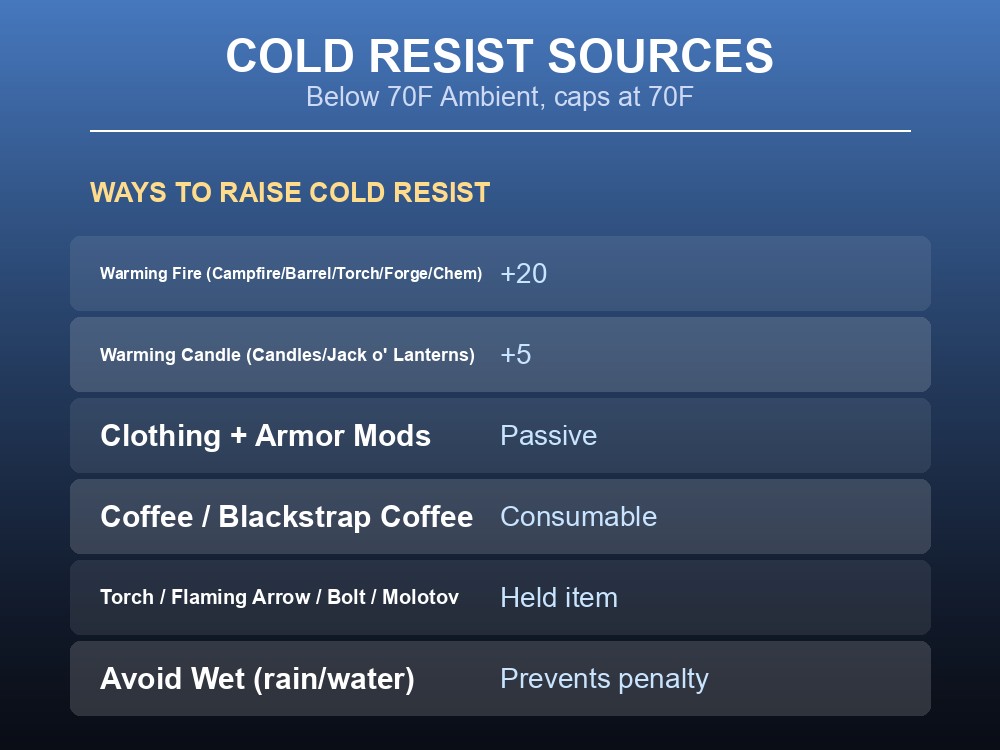
Cold Resist only activates below a line: "When the Ambient temperature is below 70°F, Cold Resist is added to calculate the character's effective or Feels Like temperature." It has a ceiling too — "Cold Resist will not bring the Feels Like temperature any higher than 70°F" — so stacking it can't push you into overheating.
Two sources carry exact numbers: "Stand near a lit Campfire, Burning Barrel, placed Torch, Forge, or Chemistry Station to receive the Warming Fire buff," and "Candles and Jack o' Lanterns provide Warming Candle, which gives only 5 Cold Resist compared to Warming Fire's 20." So Warming Fire = +20, Warming Candle = +5 — four times as much (20 ÷ 5 = 4). Sources without a listed number: Clothing; armor Mods that raise Cold Resist; Coffee or Blackstrap Coffee; a Torch or Burning Shaft Mod; a Flaming Arrow/Crossbow Bolt; a lit Molotov Cocktail. One thing to avoid: "Avoid going into water or outdoors during rain which cause the Wet status" — Wet works against Cold Resist, the source's one direct link between weather and cold survival.
Heat Resist, the Safe Range, and Hot/Sweltering Thresholds
Heat Resist mirrors Cold Resist: "When the Ambient temperature is above 70°F, Heat Resist is subtracted to calculate the character's effective or Feels Like temperature. Heat Resist will not bring the Feels Like temperature any lower than 70°F." The same 70°F line floors heat exactly as it ceilings cold. Documented sources: Clothing; armor Mods that raise Heat Resist; a Yucca Juice Smoothie; and, deliberately, "Go into water or outdoors during rain in order to become Wet" — the same Wet status that hurts you cold helps you when overheating.
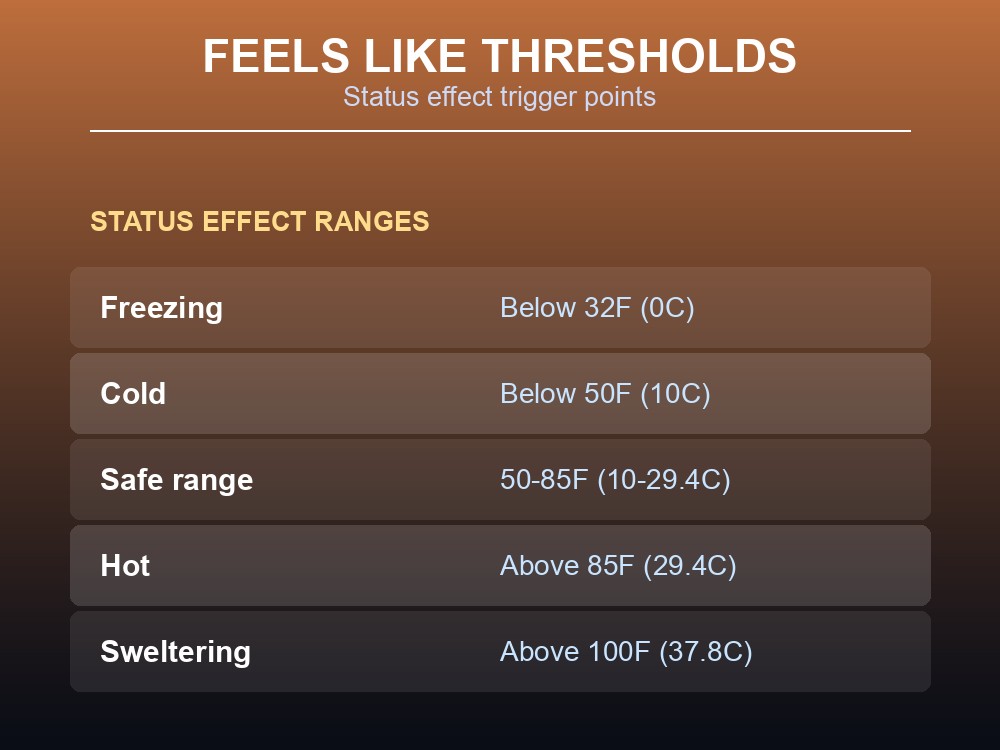
The full threshold ladder, quoted directly: the safe zone is "50°F (10°C) to 85°F (29.4°C)." Below it, "When the Feels Like temperature drops below 50°F, the status effect Cold is applied," and further down, "below 32°F, the status effect Freezing is applied." Above it, "above 85°F, the status effect Hot is applied," and further up, "above 100°F, the status effect Sweltering is applied." Converting the two thresholds the source left in °F only, using (°F − 32) × 5⁄9: 32°F = 0°C, and 100°F = 68 × 5⁄9 ≈ 37.8°C.
Practical tips
- Watch Feels Like, not Ambient — Ambient can read cold while your Cold Resist keeps Feels Like safe.
- Fire sources give +20 Cold Resist (Warming Fire); Candles/Jack o' Lanterns only give +5 (Warming Candle) — pick fire when it's genuinely cold.
- Cold Resist and Heat Resist both cap at 70°F Feels Like — neither can push you into the opposite extreme.
- Getting Wet cuts both ways: avoid rain/water when cold, seek it out deliberately when overheating.
- Safe range is 50–85°F (10–29.4°C); below 32°F you're Freezing, above 100°F you're Sweltering.
Running your own 7 Days to Die server
Temperature math runs independently for every player on a dedicated server — each character calculates their own Ambient and Feels Like from their own biome, shade, and gear, so a group spread across a Wasteland base and a snowy outpost sees different numbers at the same in-game moment. A gamever 7 Days to Die server keeps the world running 24/7 so biome cycles and storms keep progressing even when players log off individually, and gives you direct config access if your group wants to verify Player Info readings. Renting one takes minutes, and new servers get a free trial with promo code WELCOME.
Conclusion
Ambient temperature is the environment; Feels Like temperature is what triggers status effects — Cold below 50°F, Freezing below 32°F, Hot above 85°F, Sweltering above 100°F, with a safe range of 50–85°F (10–29.4°C) in between. Cold Resist and Heat Resist both work off the same 70°F pivot, and both are hard-capped so neither flips you into the opposite extreme. Warming Fire's +20 Cold Resist beats Warming Candle's +5 four to one, and getting Wet is the one weather effect the source documents in detail — bad when cold, useful when overheating. Exact storm-driven temperature swings, rain frequency, and per-biome weather patterns aren't broken out in the source, so build gear choices around the documented Feels Like thresholds rather than guessing at storm severity.