
How Looting and Loot Respawn Work in 7 Days to Die
Looting is the player activity of searching for and gathering Resources referred to as Loot, found as "Clothing or Armor, Weapons, and Food... in all kind of Containers within the various Points of Interest." The wiki is explicit that "the quality and quantity of loot you obtain by opening a previously-unopened Container is determined by your Loot Stage and influenced by your Loot Bonus," and that on "very rare occasions players will find complete items such as vehicles or robotics defense items" — no drop rate is given for that rare case, so treat it as undocumented. This guide covers what actually moves your Loot Stage, how the game's own loot-group math picks an item, and how long an emptied container takes to refill. (The wiki's page infobox carries no additional structured values beyond the article text — undocumented.)
What Actually Sets Your Loot Stage
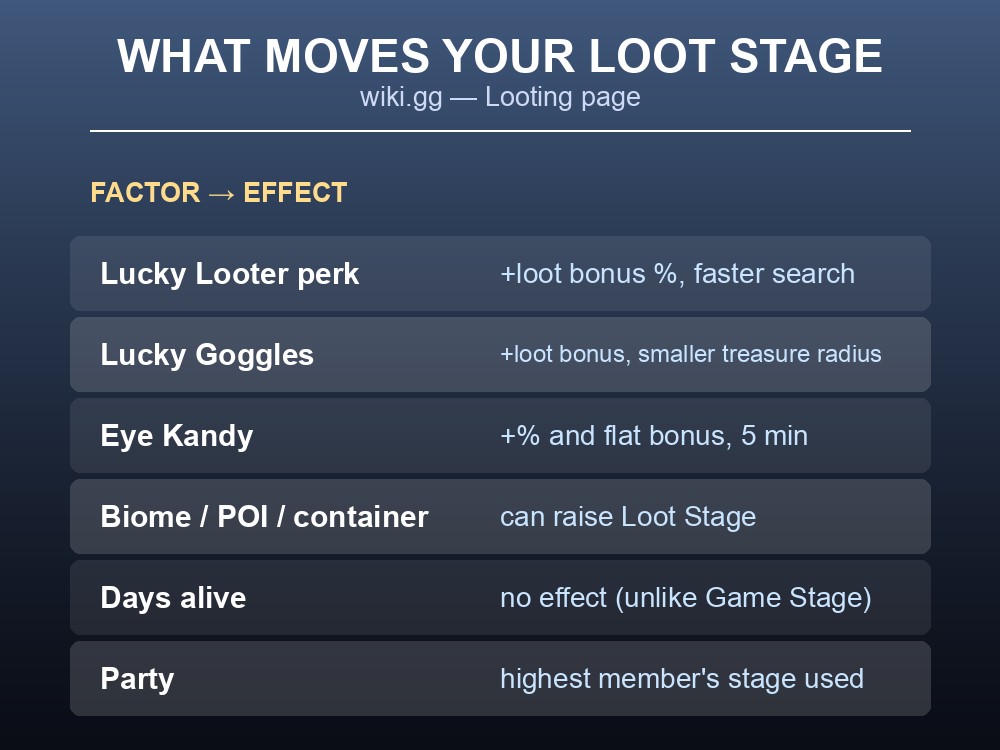
Loot Stage is its own separate measure, not a byproduct of Game Stage: "As of Alpha 20, Loot Stage is a separate measure which increases similar to Game Stage, but with additional bonuses available." Those additional bonuses, named directly by the source: "the Lucky Looter perk, the Lucky Goggles, and Eye Kandy," plus "the biome, POI, and even the specific container being looted." One factor is explicitly ruled out: "Unlike Game stage, the number of days the player has been alive does not affect the Loot Stage." You can check your own number two ways — "the player's current Loot Stage is visible in the player details screen, and the console 'gamestage' command will show it as well." In a group, there's no averaging: "If playing in a party, the highest Loot Stage of party members is used when a container is opened."
Ordinary Loot vs. the Four Loot-Stage Tiers
Not all loot cares about your Loot Stage. "Much of the loot in the game is not affected by Loot Stage" — mundane containers ("think: not safes, lockboxes, loot-room boxes, or lootables obviously designed to return armor/weapons/tools/books") run on fixed probabilities set in loot.xml. What is Loot-Stage-scaled: "nearly all tiered loot (tools, weapons, and armor) as well as books, schematics, mods, ammo, recipes, and parts." The source names four tiers: Tier 0 is "primitive items, usually available from the beginning of the game or very early... stone tools/weapons, padded and scrap armor and basic mod schematics"; Tier 1 is "usually items made of iron, such as iron tools, weapons and armor, first proper weapons outside of blunderbuss and schematics for items in the next tier"; Tier 2 is "the first items made from steel and consist of the best available melee weapons and armor, rarest schematics and the best food recipes"; Tier 3 is "the best firearms, tools and vehicles in the game."
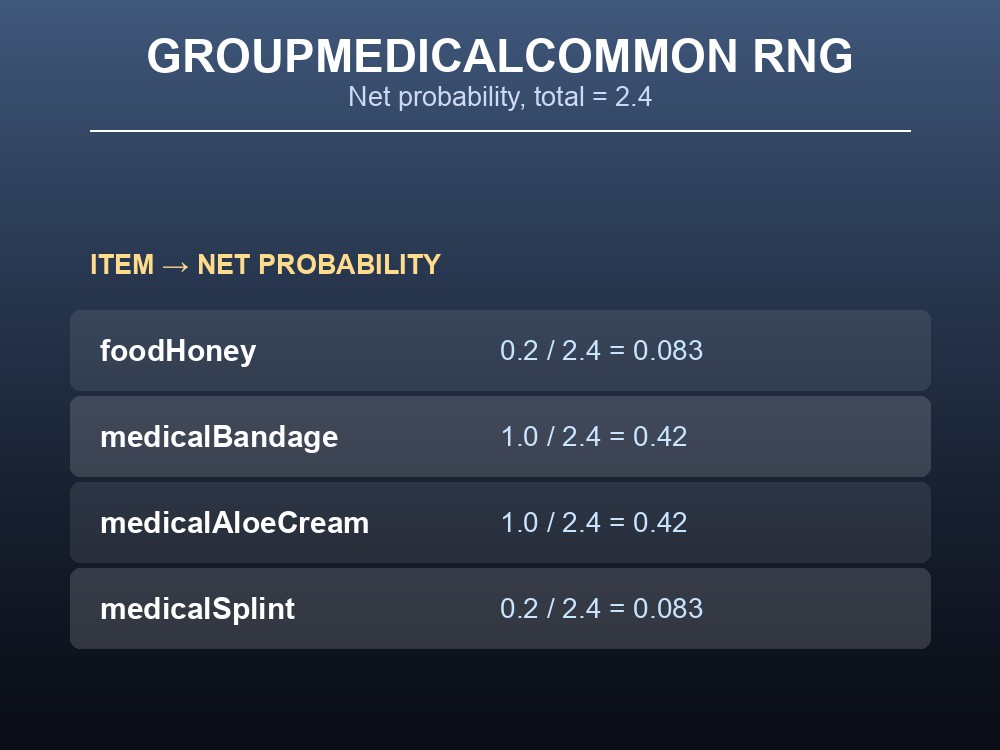
The wiki's own worked example shows how a fixed-probability group resolves: the group groupMedicalCommon (count="1") holds foodHoney and medicalSplint at a "low" template (a fixed 0.2 at every Loot Stage) alongside medicalBandage and medicalAloeCream at the unmarked default of 1.0 each. Summed: 0.2 + 1.0 + 1.0 + 0.2 = 2.4. Dividing each item by that total gives the net pick probability: foodHoney = 0.2 / 2.4 = 0.083, medicalBandage = 1.0 / 2.4 = 0.42, medicalAloeCream = 1.0 / 2.4 = 0.42, medicalSplint = 0.2 / 2.4 = 0.083. The source then converts that straight into an RNG range: "an RNG result from 0.0 to 0.082 would select foodHoney. A result between 0.083 and 0.504 would return medicalBandage."
How the Loot RNG Actually Rolls (and What Loot Stage Changes)
Groups can nest, and count="all" behaves differently from a fixed count. In the wiki's second example, group groupSmallWeaponBag (count="all") contains a nested group drawn once by default, plus two entries flagged force_prob="true". Because of count="all", "every item without force_prob='true' is automatically selected" — so the nested groupWeaponsLowHighMed is always processed. The two force_prob="true" entries instead get "an independent RNG check vs. their raw probability": groupWeaponsHighMedLow at 0.5 (the "med" template) and groupSmallAmmoMedMed at 0.2 (the "low" template). As the source puts it, "it is quite possible for results from all three listed groups to be returned if the RNG is favorable."
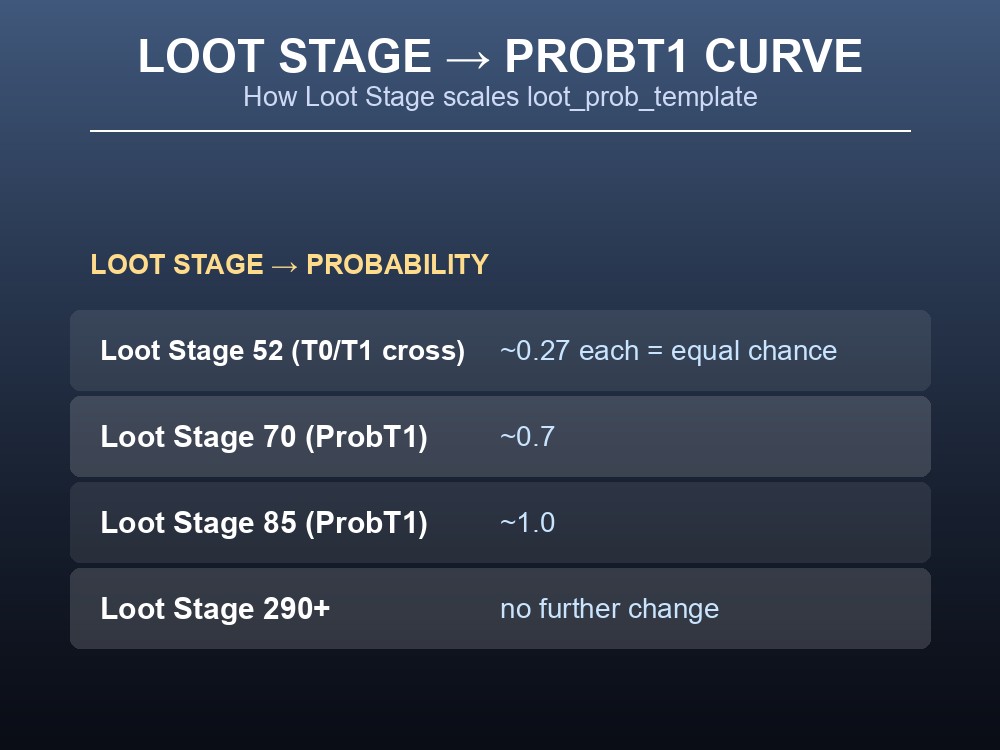
Loot Stage only ever touches one piece of that math: "the only thing Loot Stage scaling changes is the 'loot_prob_template' properties." A template like ProbT1 translates your current Loot Stage into a probability on a curve — the source's own example: at Loot Stage 70, ProbT1 maps to "approximately 0.7"; at Loot Stage 85, that same item's probability is "near 1.0." The curve stops moving entirely once you're past it: "after Loot Stage 290 there are no further changes to the probabilities." Tier 2 items with no Tier 3 equivalent (books, for instance) run on a separate "Tier 2 (Cap)" curve, specifically so they "can still find them throughout the late game." One reading trap the source calls out directly: at Loot Stage 52 the Tier 0 and Tier 1 curves cross at "about 0.27" each — that does not mean a 27% chance; since both tiers carry the same weight there, "it means they have equal chance of being selected."
Practical tips
- Empty containers respawn new loot after 30 days by default — this is a world-setup option, changeable in the main menu before you start a game.
- Lucky Looter increases your loot bonus "by a percentage" (exact figure undocumented here) and cuts the time needed to search an already-unopened container.
- Lucky Goggles increase loot bonus and shrink the buried-treasure search radius on treasure-map quests.
- Eye Kandy adds a percentage and a flat loot-bonus boost, but only "for five minutes."
- Days survived never raises your Loot Stage — the wiki names the Lucky Looter perk, Lucky Goggles, Eye Kandy, your biome, the POI, and the specific container as what affects it instead.
- Send whoever in your party has the highest Loot Stage to open the valuable containers — the party uses that single highest number, not an average.
Running your own 7 Days to Die server
Loot Stage math, tier tables, and the 30-day respawn timer all live in the same loot.xml/biomes.xml files a dedicated server reads. A gamever 7 Days to Die server keeps that config within easy reach if your group wants to shorten (or lengthen) the container respawn window, runs the world around the clock so nobody's Loot Stage or party position resets between sessions, and takes one-click backups before anyone edits loot-affecting XML so a bad change is reversible. New servers spin up in minutes, and you get a free trial with promo code WELCOME.
Conclusion
Loot Stage — not Game Stage, not days survived — is the number that decides what a container gives you, built from the Lucky Looter perk, Lucky Goggles, Eye Kandy, your biome, the POI and even the specific container, with the party's highest value used for everyone. Fixed-probability "ordinary" loot and the four Loot-Stage-scaled tiers (T0 primitive through T3 best firearms/tools/vehicles) resolve through the same net-probability math the wiki's own groupMedicalCommon example works out to 0.083/0.42/0.42/0.083, and Loot Stage itself only ever bends a loot_prob_template curve, capping out past Loot Stage 290. Layer the 30-day default respawn timer on top of that, and you have the full documented picture — with the exact rare-item drop rate and the precise Lucky Looter/Eye Kandy percentages flagged honestly as gaps the source doesn't fill.