
How Game Stage Works in 7 Days to Die
Every hour you survive in 7 Days to Die quietly moves a single hidden number that decides how hard the game hits back. Per the wiki, "Game Stage is a calculated value which represents your progression and survival skill" — you can see your own score, and everyone else's in multiplayer, right on the Players information screen. It drives horde size and composition, but it does not drive loot, which runs on a separate number called Loot Stage. This guide walks through both formulas, the wiki's own worked examples, and the couple of places the source page's documentation stops short — no filled-in guesses, just what the calculation logic actually says.
What Game Stage Controls — and What It Doesn't
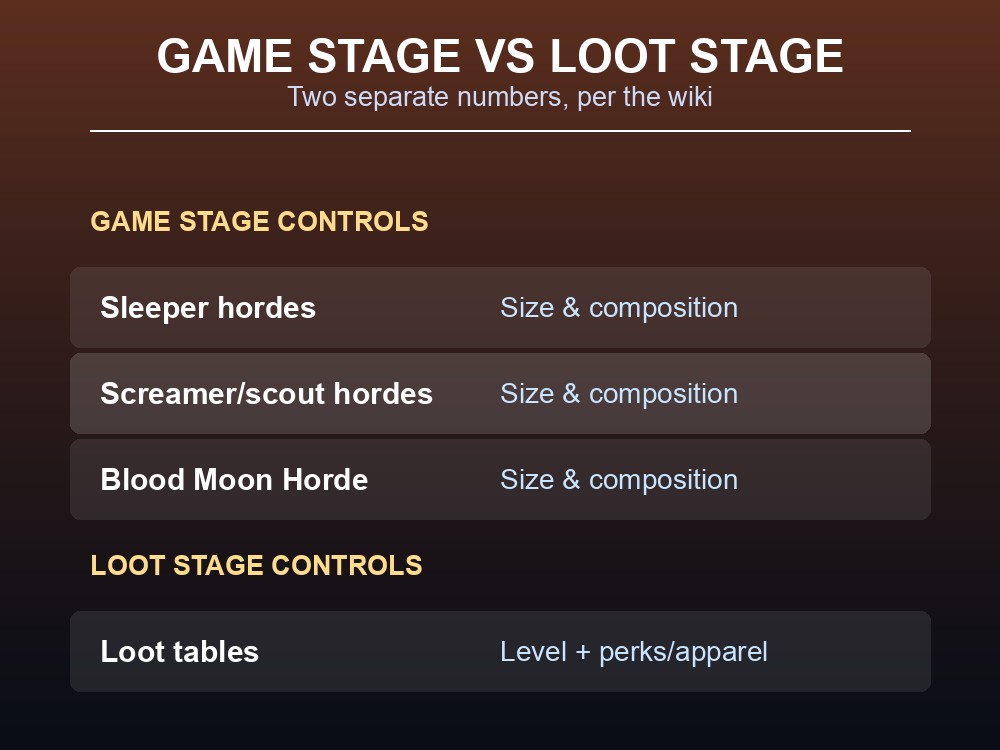
The wiki's description section spells out exactly what Game Stage drives: the size and composition of sleeper hordes, of screamer/scout hordes, of "special-purpose hordes," and of every Blood Moon Horde. What it does not touch is loot — the wiki is explicit that "Loot is not dependent on Game Stage, but instead a separate variable known as Loot Stage, which only takes into account player level and its own modifiers."
Game Stage's reach grew over several updates, per the wiki's own history log: Alpha 15 "added Game Stage," and it "only applied to Blood Moon Hordes." Alpha 16 expanded it to "Wandering Hordes, Screamer Hordes, and the new sleeper spawns." Alpha 20 made biomes other than the Pine Forest start boosting Loot Stage, and Alpha 21 extended that same biome boost to Game Stage itself. The wiki doesn't say how large those biome boosts are, so treat that part as documented in direction only, not magnitude — and there's no infobox stat block on this page either, only the calculation write-up itself, so every number below traces back to a formula rather than a lookup table.
How Solo Game Stage Is Calculated
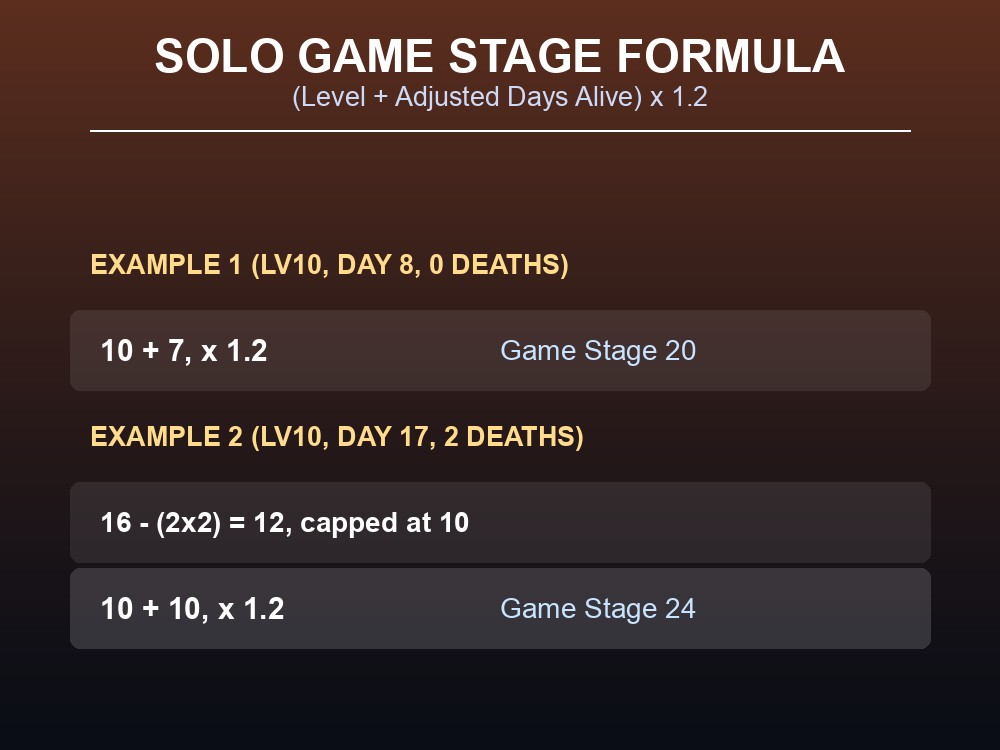
Single-player Game Stage runs on one formula: ([Player Level] + [Adjusted Days Alive]) × [Difficulty Factor]. Player Level is "just what it says on the tin — your level, unadjusted." Adjusted Days Alive is the total in-game days elapsed, "adjusted by subtracting the value of 'daysAliveChangeWhenKilled' (in gamestages.xml) for each death the character has suffered, and then capped at [Player Level] if necessary." The Difficulty Factor is currently fixed: "as of Alpha 19, this is set to 1.2, with no change based on game Difficulty setting" — though the wiki notes "previously, higher difficulty settings had higher factors" without listing what those older values were, so that part stays as history rather than something computable today. Fractional results are dropped, not rounded up.
The wiki's own examples show the math end to end. Example 1: a level-10 player on day 8 (7 days survived, no deaths) has no death penalty, so (10 + 7) × 1.2 = 20.4, dropped to Game Stage 20. Example 2: a level-10 player on day 17 (16 days survived) with two deaths, at the default penalty of 2 days per death: Adjusted Days Alive = 16 − (2 × 2) = 12, then capped at Player Level (10) since 12 exceeds it, so the calculation becomes (10 + 10) × 1.2 = 24. Both the death penalty and the level cap bite in that second example, which is why two deaths cost more Game Stage than the raw 4-day subtraction alone would suggest.
Party Game Stage, Blood Moon Multiplayer, and Loot Stage
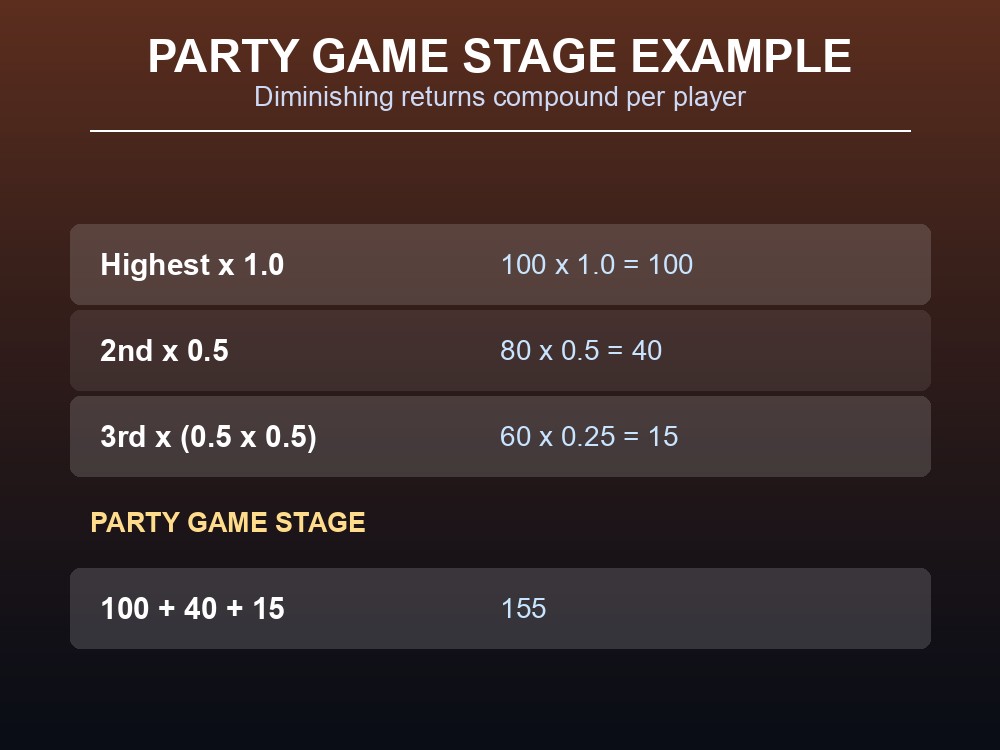
Grouping up changes the formula entirely. Party Game Stage sorts each player's individual score highest to lowest and combines them with diminishing weight: the highest is multiplied by startingWeight ("default in A19 is 1.0"), the next-highest by diminishingReturns ("default in A19 is 0.5"), and each subsequent player's score is hit by that same diminishingReturns factor again on top of the last — compounding, not flat. The wiki's own three-player example shows it directly: Game Stage 100, 80, and 60 combine as (100 × 1.0) + (80 × 0.5) + (60 × (0.5 × 0.5)) = 100 + 40 + 15 = 155.
That same party math extends to Blood Moon Hordes on multiplayer servers: when the horde triggers, the game treats "nearby players" as a party and calculates a party Game Stage for that local event — though the wiki is explicit that the precise definition of "nearby" is undocumented here ("details are not specified; see gamestages.xml"). Once the event starts, anyone logging in or out doesn't change that local party's Game Stage.
Loot Stage runs on a completely different party rule: instead of the weighted Party Game Stage formula, "the effective Loot Stage for all party members is the highest Loot Stage in the party" — full stop, no diminishing returns. Perks and gear still only benefit the person wearing them, though, which is why the wiki suggests letting "the party member with the most invested in Lucky Looter, or having the Treasure Hunters Mod equipped," be the one who opens the big containers.
Check your own Game Stage on the Players screen before a Blood Moon so you have a rough sense of the horde size you're walking into. In a party, remember the second- and third-highest members only add a fraction of their score (50%, then 25% of theirs) — staying alive matters more than out-leveling everyone else, since every death costs Adjusted Days Alive directly. And don't assume a high Game Stage means better loot: send whoever has the deepest Lucky Looter investment to open safes and weapon caches, since party Loot Stage is just the single highest score in the group, not a blend.
Running your own 7 Days to Die server
Testing how Game Stage scales — solo, in a duo, or across a full server on Blood Moon night — is a lot easier on a dedicated box where you control player count, difficulty settings, and horde frequency instead of sharing someone else's public server. Get your own 7 Days to Die server running in minutes, free with promo code WELCOME.
Conclusion
Game Stage is 7 Days to Die's single hidden difficulty dial: one clean formula for solo play — (Level + Adjusted Days Alive) × 1.2 — a compounding weighted formula for parties, and a completely separate Loot Stage system that never touches either. The wiki's own worked examples check out exactly (Game Stage 20, Game Stage 24, and a 155-point party score), and the two places its documentation goes quiet — the exact biome-boost magnitudes from Alpha 20/21, and what "nearby players" means for a multiplayer Blood Moon — are flagged here rather than filled in with a guess.