
Factorio Fulgora Planet Guide: Lightning, Scrap Recycling and Getting There
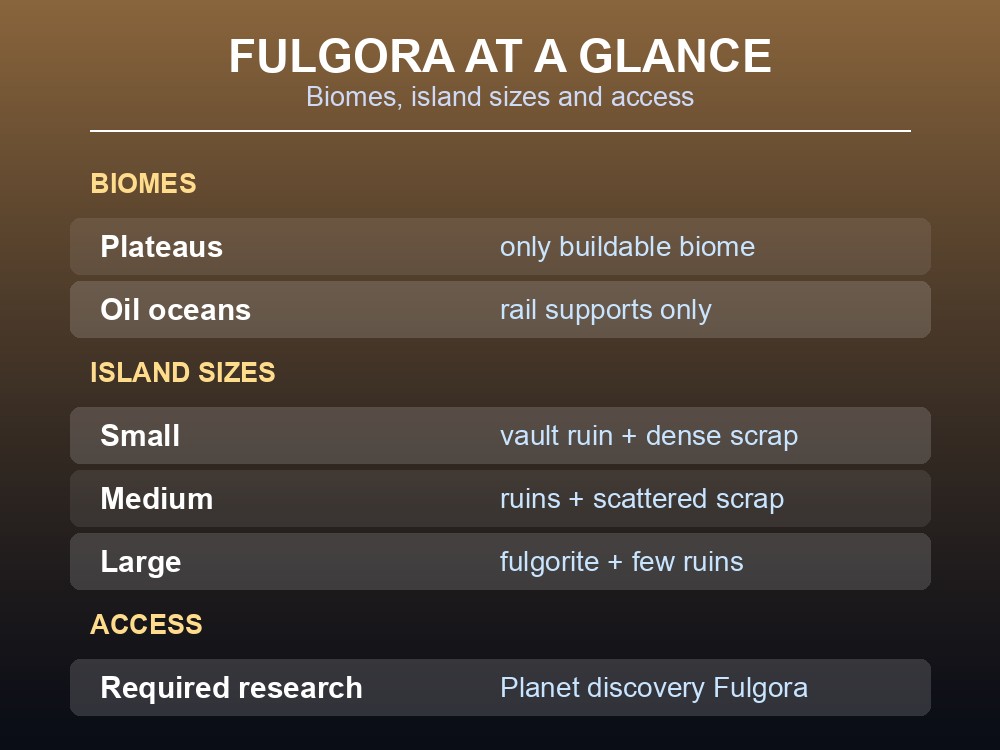
Fulgora is one of the new planets added in the Space Age expansion, and the wiki describes it plainly: "Fulgora is a new barren desert planet. Its surface is split between island-like plateaus, and deep oilsands. During the night, the planet is ravaged by lightning storms, damaging buildings." You need the Planet discovery Fulgora research before you can travel there at all. Once you land, the rules change: there's no ore to mine, travel between islands usually means a train, and the thing that damages your base at night is also your best power source once it's under control.
What Fulgora Is: Biomes, Islands and Access
Fulgora splits into two biomes. Plateaus are the islands scattered across the landscape — the only biome where factories can be built, and some hold alien ruins and Fulgoran lightning attractors that protect you at night until you build your own lightning rods. Oil sands (oil oceans in-game) are the lowlands between plateaus; per the wiki, "No buildings can be built in them except for rail supports." Deep oil oceans slow foot travel to a crawl, but an offshore pump on the shore produces heavy oil in unlimited amounts.
Islands come in three size classes: small islands always have a Fulgoran vault ruin, other ruins, and a dense scrap pile; medium islands have larger ruins and smaller scattered scrap patches; large islands carry no resources besides some fulgorite and a few ruins. Islands are often detached, and the wiki notes the gaps are frequently "too vast for roboports or big electric poles to reach" — so each island typically needs its own local logistics and electric network until the foundation technology is researched.
The wiki's structured infobox for Fulgora is currently blank, and its "Surface" and "Orbit" sections carry no text either, so there's no documented figure here for things like total surface area — this guide sticks to what the body text and tables confirm.
Scrap: The Only Resource You Mine
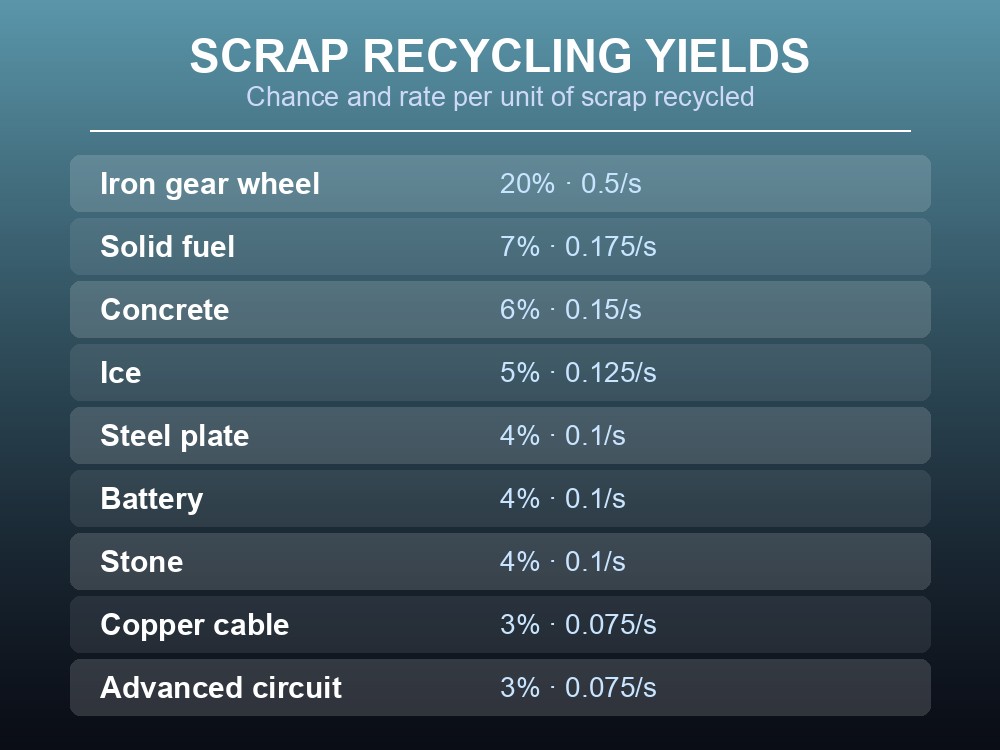
Besides items pulled from ancient ruins, Fulgora has exactly two "natural" resources: heavy oil, and scrap, found in deposits on small and medium islands "as if it were an ore." Scrap doesn't behave like a normal resource, though — the wiki is explicit: "scrap is not directly processed into a single basic resource like iron or copper plates using traditional production methods. Rather, it is recycled to produce a variety of items."
Recycling one unit of scrap can output, by documented chance and rate per second: iron gear wheel (20%, 0.5/s), solid fuel (7%, 0.175/s), concrete (6%, 0.15/s), ice (5%, 0.125/s), steel plate (4%, 0.1/s), battery (4%, 0.1/s), stone (4%, 0.1/s), copper cable (3%, 0.075/s), advanced circuit (3%, 0.075/s), processing unit (2%, 0.05/s), holmium ore (1%, 0.025/s), and low density structure (1%, 0.025/s). Since that list has intermediates like advanced circuits but never plain iron or copper plates, the wiki says outright that "players are generally forced to further recycle many of these items in order to obtain their ingredients" — plan on a recycling chain, not a single pass.
Lightning: Nightly Threat and Free Power
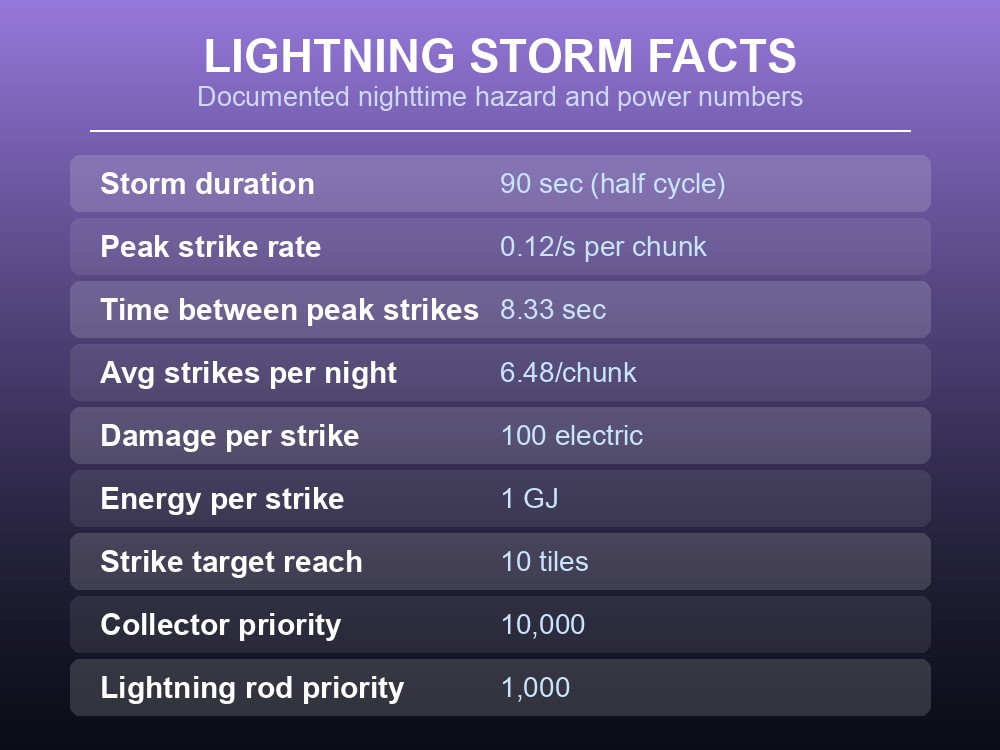
The wiki frames its numbers as testing-derived ("very likely" behavior, not confirmed constants), but they're specific. A storm runs 90 seconds, spanning half the day/night cycle. At peak intensity each chunk expects 0.12 strikes per second — one strike roughly every 8.33 seconds (1 ÷ 0.12 = 8.33) — and a full night averages 6.48 strikes per chunk. Each strike deals 100 electric damage and carries 1 GJ of energy that lightning attractors, rods and collectors can capture, targeting within 10 tiles of its source; collectors (priority 10,000) and rods (priority 1,000) outrank every other structure for where a bolt lands.
That capture mechanic doubles as Fulgora's power plan, and the wiki explains why: solar panels "receive an 80% penalty on Fulgora, producing only 12 kW, or ~1.3 kW per tile," calling the result "effectively worthless." Lightning rods and collectors convert strikes into stored power instead, and paired with enough accumulators to carry a base through daylight hours, the wiki says this "can serve as the factory's main power source." Leave a plateau uncovered, though, and the same storms wreck it.
Reaching Fulgora and What You Can Only Build There
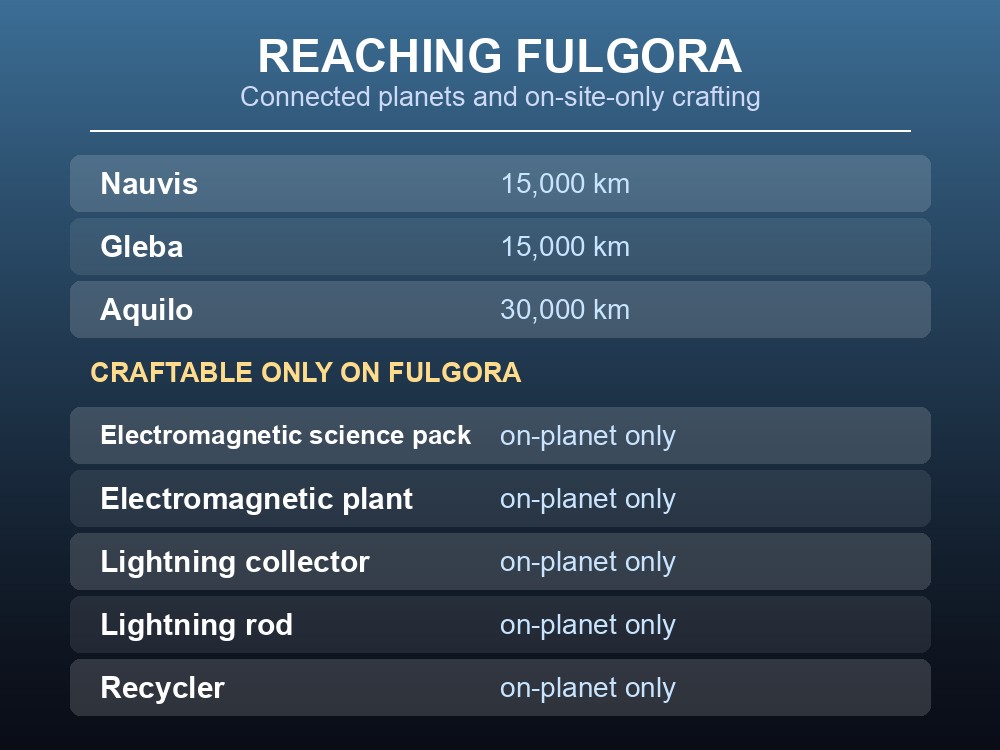
Per the wiki's Space routes table, Fulgora connects to Nauvis (15,000 km), Gleba (15,000 km), and Aquilo (30,000 km) — the Aquilo leg is exactly twice as far as either other route (30,000 ÷ 15,000 = 2).
Once you've landed, five items can only be crafted on Fulgora itself: the electromagnetic science pack, electromagnetic plant, lightning collector, lightning rod, and recycler. A second group unlocks on Fulgora but can be crafted elsewhere afterward — mech armor, personal battery MK3, energy shield MK2, personal roboport MK2, quality module 3, and the Tesla turret, per the wiki's Exclusive Items list.
Fulgora checklist
- Research Planet discovery Fulgora before you can travel there at all.
- Build only on plateau islands — oil oceans won't take buildings until foundation tech is researched.
- Cover every base with lightning rods or collectors before your first night, or expect 100 damage per hit.
- Scrap recycles into a mix of intermediates — plan to recycle twice, not once.
- Skip solar entirely (~1.3 kW per tile); lean on lightning + accumulators instead.
- Budget the extra distance routing on to Aquilo — double the Nauvis/Gleba hop.
Running your own Factorio server
None of this changes what a dedicated server needs to do: keep the save running and keep everyone's progress synced while your group is offline grinding scrap. A gamever Factorio server exposes the Space Age DLC toggle and a version pin (stable or experimental) as plain panel fields, so your whole crew lands on the same build before anyone starts shipping electromagnetic tech home. Map settings, autosave intervals and the admin list live in strict JSON files edited through the File Manager, with scheduled backups so a bad night of lightning damage never costs you the base.
Conclusion
Fulgora runs on different rules than anywhere else in Factorio: no ore, just scrap that has to be recycled — often more than once — into the parts you actually need; no safe solar power, just lightning that damages an uncovered base and, once tamed with rods and collectors, becomes the planet's best power source; and no quick travel between islands, just trains, because the plateaus are often too far apart for electric poles or roboports to bridge. Get Planet discovery Fulgora researched, cover your first base before night one, and the electromagnetic tech you can only make here is worth the trip.
Ready to run a Space Age-capable Factorio server for your group? Spin one up at gamever.io with the Space Age DLC toggle built into the panel, scheduled backups, and full File Manager access — use promo code WELCOME for a free trial.