
Every Building Set in Palworld: Seven Styles, Four Strengths, and One That Is Wood at Technology 49
Palworld has seven building sets — Wooden, Stone, Metal, Glass, Japanese-Style, Clean and Ancient — each with the same roughly nineteen pieces. What almost nobody checks is that they are not seven tiers. Their foundations carry only four distinct defence values and four distinct health values, and one of them is a genuine trap.
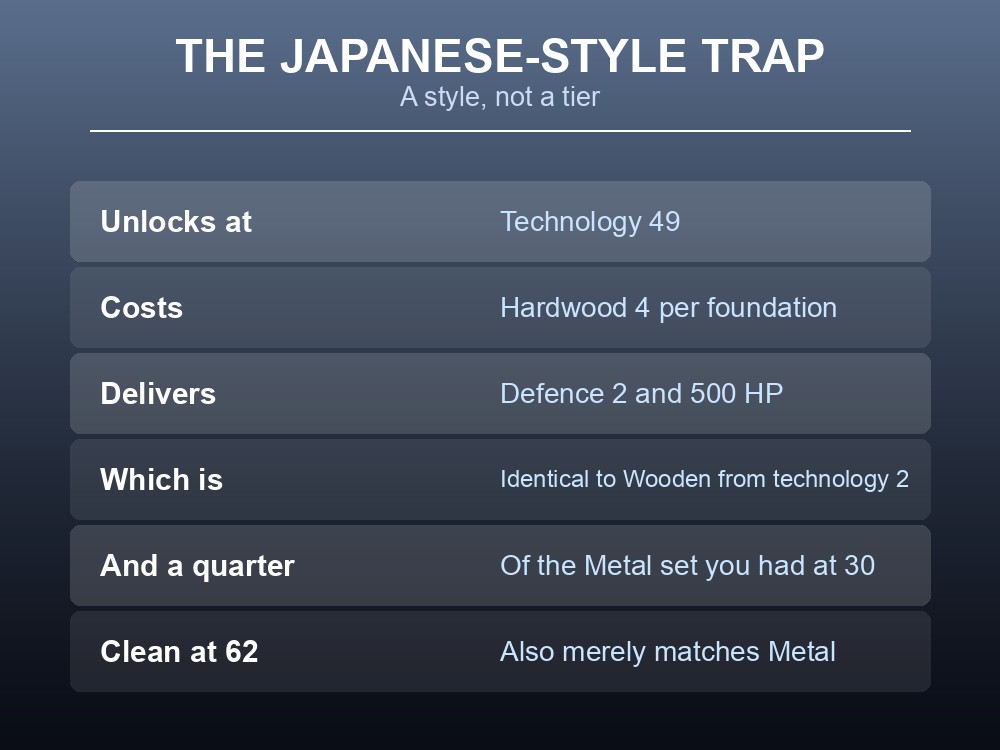
The Japanese-Style set unlocks at technology 49 and is exactly as strong as the Wooden set at technology 2: defence 2, 500 HP.
The Seven Sets, By Strength
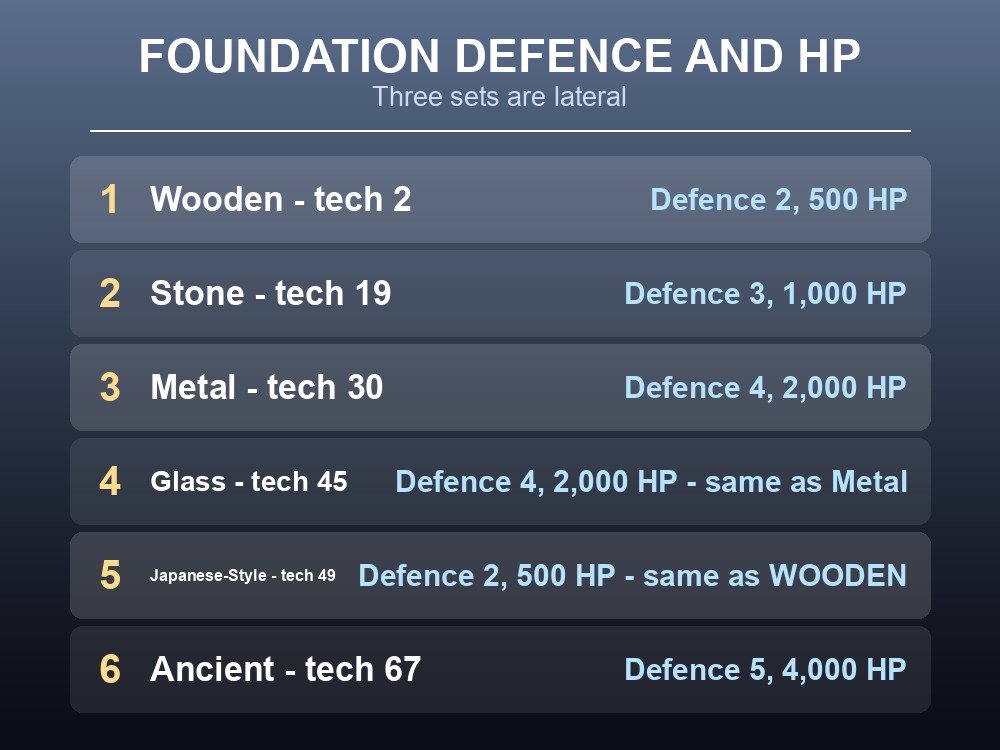
Foundation values, which the rest of each set follows:
| Set | Technology | Foundation cost | Defence | HP |
|---|---|---|---|---|
| Wooden | 2 | Wood 2 | 2 | 500 |
| Stone | 19 | Stone 3 | 3 | 1,000 |
| Metal | 30 | Ingot 1, Stone 2 | 4 | 2,000 |
| Glass | 45 | Stone 1, Paldium Fragment 2 | 4 | 2,000 |
| Japanese-Style | 49 | Hardwood 4 | 2 | 500 |
| Clean | 62 | Polymer 1 | 4 | 2,000 |
| Ancient | 67 | Soralite Ingot 2 | 5 | 4,000 |
Only four strengths exist across seven sets. Defence runs 2 / 3 / 4 / 5 and health runs 500 / 1,000 / 2,000 / 4,000 — everything else is repetition.
Japanese-Style is the trap. At technology 49 it costs 4 Hardwood and delivers defence 2 and 500 HP — identical to the Wooden set you unlocked at technology 2, and a quarter of the health of the Metal set you had at 30. It is a style, not an upgrade.
Glass and Clean are also lateral. Both sit at defence 4 and 2,000 HP, exactly matching Metal from technology 30. Glass at 45 and Clean at 62 buy you appearance and a different material cost — nothing structural.
Only two sets are real upgrades after Metal: none until Ancient at technology 67, which doubles health to 4,000 and is the only set at defence 5.
What Each Set Actually Costs
The material is the real difference between the lateral sets, and it decides which one suits your base:
- Metal — Ingot 1 + Stone 2. Cheap and available from technology 30 onward. The default.
- Glass — Stone 1 + Paldium Fragment 2. Trades metal for Paldium, which competes directly with your sphere production.
- Clean — Polymer 1. A single unit of a refined material, so it is light on quantity but gated behind Polymer manufacturing.
- Japanese-Style — Hardwood 4. The most material per piece of any set except Ancient, for the weakest result on the list.
- Ancient — Soralite Ingot 2. Endgame material, and the only one that buys a genuine defensive step.
Glass costing Paldium Fragment is the quiet cost. Paldium is the base material of every sphere in the game; a large glass build directly reduces how many Pals you can catch that week.
Clean is the efficient cosmetic choice. One Polymer per foundation, at Metal-equivalent strength.
Why Defence and HP Matter
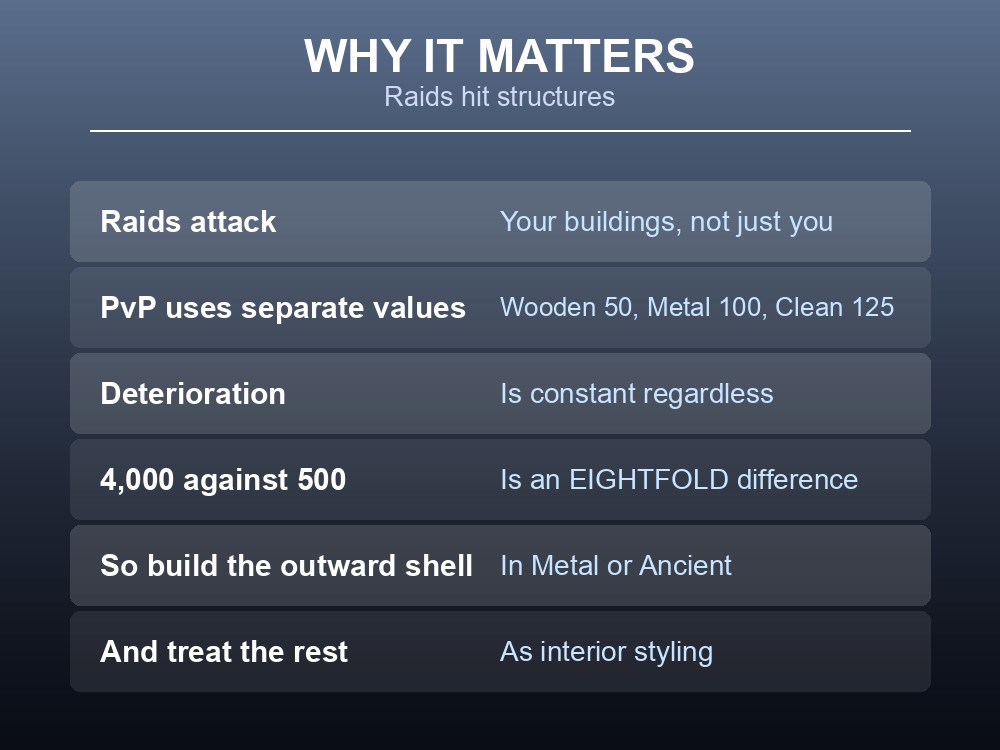
These are not decorative statistics:
- Raids attack your buildings. A base under attack loses structures, and health is what decides whether the raid ends with a repair bill or a rebuild.
- PvP uses separate values. Each foundation lists a Defense_PVP figure well above its PvE one — Wooden 50, Stone 75, Metal 100, Clean 125 — so structural choice matters more on a PvP server, not less.
- Deterioration is constant. Structures decay over time and need repair regardless of attacks.
- Four thousand against five hundred is an eightfold difference. That is the real gap between an Ancient base and a Japanese-Style one.
Build the shell in Metal, then re-skin. The sensible pattern is to use whichever set is strongest for the walls that face outward, and treat Japanese-Style and Glass as interior styling.
Which Set to Build
- Technology 2–18: Wooden. There is nothing else, and it breaks easily by design.
- Technology 19: Stone. Double the health for one extra stone per foundation — the cheapest upgrade in the game.
- Technology 30: Metal. Defence 4, 2,000 HP, and nothing improves on it for 37 technology levels.
- Technology 45–62: Glass, Japanese-Style or Clean — for looks only. Two of them match Metal; Japanese-Style is a downgrade to Wooden-tier strength.
- Technology 67: Ancient. Defence 5 and 4,000 HP, at Soralite Ingot 2 per foundation. The only genuine step above Metal.
Do not rebuild a base in Japanese-Style unless you accept the cost. It looks excellent and it will fall over four times faster than the Metal walls it replaces.
Running your own Palworld 1.0 server
A base is only worth building well if raids can happen while you are logged out, which is exactly what a persistent world means. A gamever Palworld server keeps it running with full crossplay, automatic updates and one-click backups.
Conclusion
Palworld's seven building sets are not seven tiers. Their foundations carry only four distinct defence values (2 / 3 / 4 / 5) and four health values (500 / 1,000 / 2,000 / 4,000), and three sets are lateral: Glass at technology 45 and Clean at 62 both match Metal from technology 30 at defence 4 and 2,000 HP, differing only in material — Paldium Fragment for Glass, which competes with sphere production, and a single Polymer for Clean. The trap is Japanese-Style at technology 49: it costs 4 Hardwood and delivers defence 2 and 500 HP — identical to the Wooden set from technology 2, and a quarter of Metal's health. After Metal, nothing improves until Ancient at technology 67, which is the only set at defence 5 and 4,000 HP, built from Soralite Ingot 2. Since raids target structures and each foundation also carries a much higher PvP defence value, the practical rule is to build the outward-facing shell in Metal or Ancient and treat the rest as styling.
Want a base that survives the raid? Rent a Palworld server at gamever.io — instant setup, full crossplay, automatic updates, one-click backups and 24/7 uptime. Start with a free trial and use promo code WELCOME.