
Crafting and Salvaging in Abiotic Factor: Durability, Repair Stations, and Packing Explained
Abiotic Factor's own wiki groups crafting, repairing, and salvaging together under one "Item mechanics" heading, and it opens with a blunt line: "Many items will need to be crafted throughout the game." The page carries no structured infobox for the mechanic itself — just the running page text — so this guide works directly from the wiki's own section-by-section wording on Crafting, Durability, Repairing, and Salvaging, plus the matching Object mechanics entries for Building, Dismantling, and Packing furniture.
How Crafting Actually Works
The wiki draws a clear line on where crafting can happen: "Some items can be crafted from the player's Inventory as long as they have the necessary resources, but most items will require a Crafting Bench." "Crafting an item will consume the resources required," and doing so "will generate Crafting Experience" — the source doesn't break down which specific resources any named recipe consumes, so exact recipe costs are undocumented here.
Getting a recipe in the first place runs through three separate entries on the wiki: "Recipes are learned via a variety of interactions in game" (the specific interactions aren't itemized, so that list is also undocumented), "some recipes require the player to complete a minigame on top of learning them," and "the player can share learned recipes with other players." So a recipe can arrive already known, gated behind a minigame, or handed to you by a teammate who already has it.
Durability, Repair Stations, and Salvaging Items
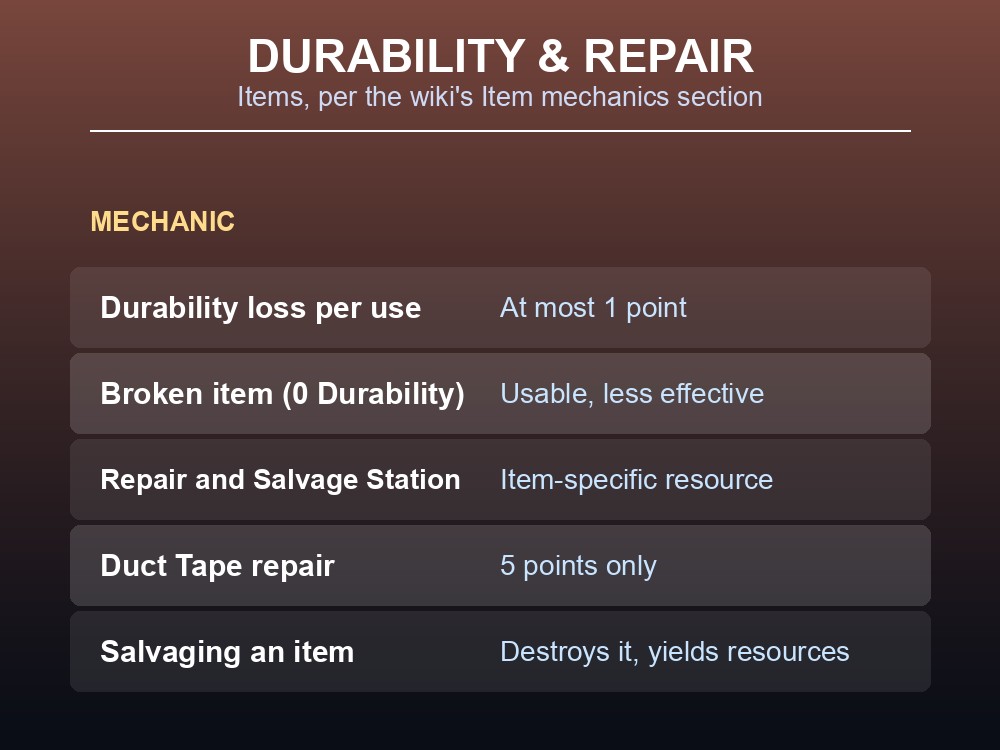
Wear works the same way across weapons and tools: "Each item has its own Durability loss chance... Items can lose at most a single point of Durability per use." Reaching zero doesn't delete the item — "an item becomes broken. Some broken items can still be used, but they may be less effective than normal." A broken weapon "can still be used, but dealing far less damage" until repaired, while broken armor "will lose its effectiveness if its Durability reaches 0, requiring repairs in order to be effective again."
The primary fix is a workstation: "Items that have lost Durability can be repaired by using a Repair and Salvage Station with each item requiring a different resource to be repaired." Which resource repairs which item isn't listed here, so that mapping is undocumented. There's a field fallback: right-click and choose "Repair with Duct Tape," but that "only repairs 5 points of Durability" — a small top-up to limp an item along between station visits, not a full repair.
Salvaging runs on the same station in reverse: "Some items can be salvaged by using a Repair and Salvage Station. Salvaging an item destroys it and generates resources depending on the item that was salvaged." The exact resource yield per item isn't broken out in this source, so treat "depends on the item" as the only confirmed rule, not a guessable formula.
Building, Dismantling, and Salvaging Furniture
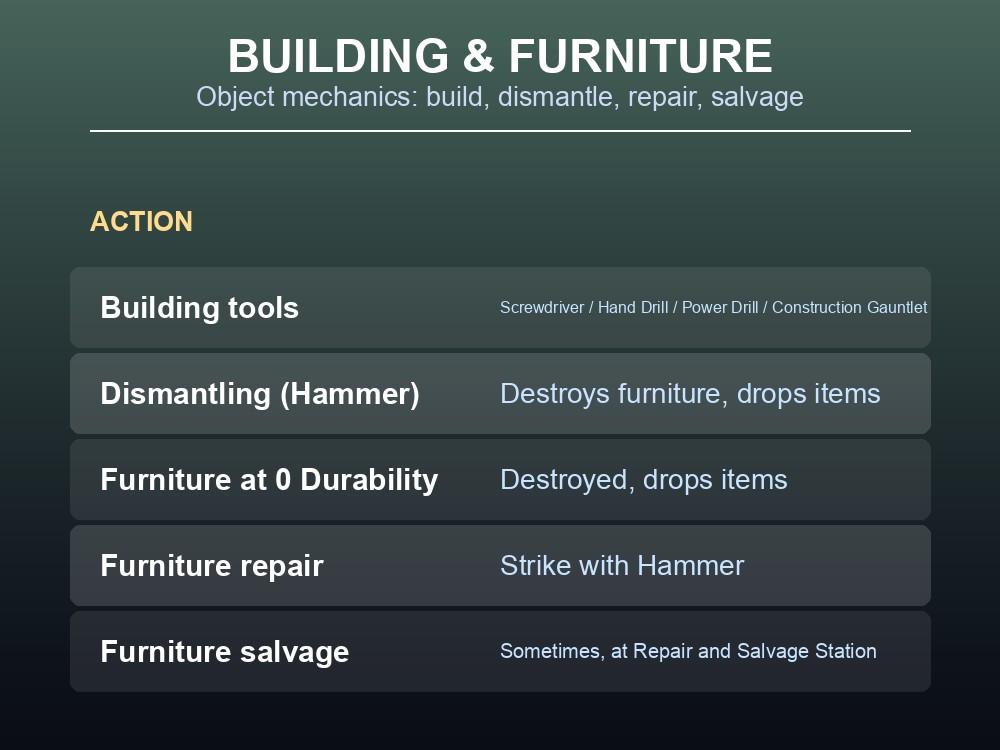
Furniture and other deployable objects have their own crafting-adjacent loop under Object mechanics. Placing one doesn't always finish it: "Some deployable objects require building after being placed. A Screwdriver, Makeshift Screwdriver, Hand Drill, Power Drill, or Construction Gauntlet is needed to build. Building generates Construction Experience." That's five separate documented tool options for the same building step.
Furniture you didn't place can be broken down directly: "Non-player placed furniture can be dismantled with the use of a Hammer... causing some items to drop, depending on the furniture that was dismantled." Furniture also degrades under attack, "eventually being destroyed and dropping some items (similarly to dismantling) if their Durability reaches zero." The fix is the same Hammer: striking damaged furniture "generates Construction Experience."
Salvaging furniture is a second, situational option: "They can also sometimes be salvaged for parts at a Repair and Salvage Station." The wiki's own word is "sometimes" — which furniture qualifies versus Hammer-only dismantling isn't specified, so that split is undocumented.
Packing Furniture Back Into Your Inventory
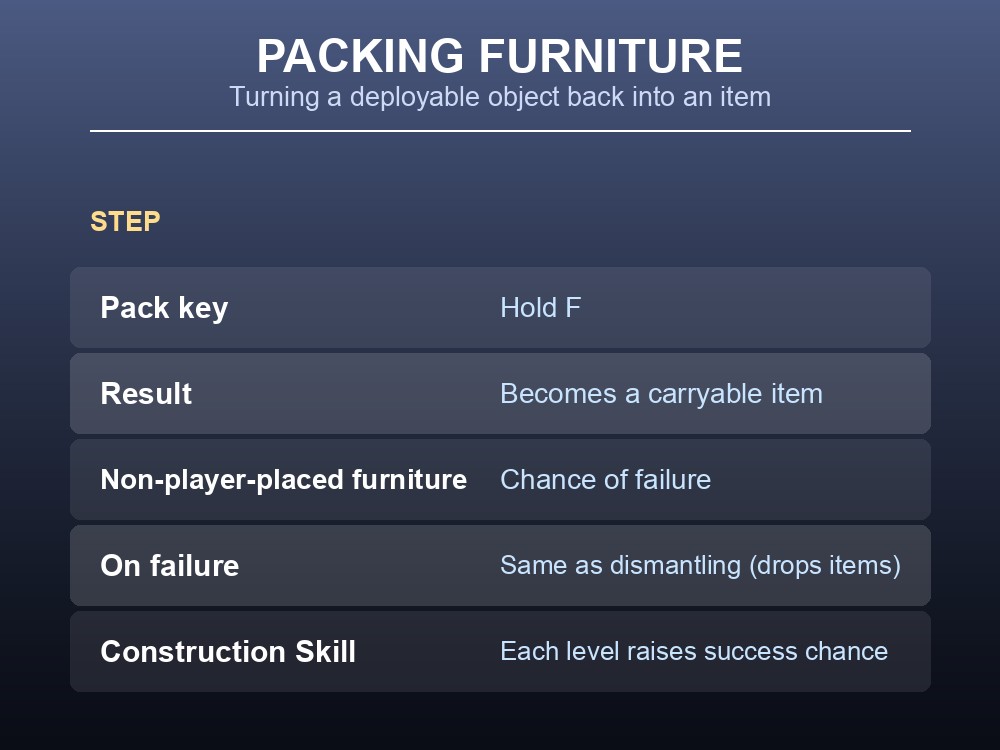
There's a third option beyond dismantling and salvaging: packing. "Furniture and other deployable objects can be packaged by holding down the F key," turning it "into an item that can be carried in the player's inventory" — a clean, reversible move for anything you placed yourself.
It's riskier on furniture you found rather than built: "Packaging non-player placed furniture found throughout the game has a chance of failure — failing to package an item earns the same result as dismantling it, causing items to drop depending on the furniture that was attempted to be packaged." The exact failure percentage isn't stated in this source, so that number is undocumented, but the mitigating factor is: "Each level of the player's Construction Skill increases the chances of packaging the object successfully."
Practical tips
- Craft from your Inventory when you can, but budget for a Crafting Bench on most recipes — the wiki says "most items will require" one.
- Treat Duct Tape as an emergency top-up, not a real repair — it only restores 5 points of Durability, versus an item-specific fix at a Repair and Salvage Station.
- Try a Hammer on non-player-placed furniture before writing it off; dismantling drops its constituent parts rather than wasting the object entirely.
- Raise Construction Skill before you try packing furniture you didn't build yourself — each level improves the odds you carry it away instead of triggering a dismantle-style drop.
Running your own Abiotic Factor server
Learning recipes, building up Construction Skill, and stocking a base with Crafting Benches and Repair and Salvage Stations all take real playtime to set up. A dedicated Abiotic Factor server keeps that progress — crafted gear, built furniture, unlocked recipes — online and intact for your whole team, with automatic backups protecting it through crashes or patches. Get started with promo code WELCOME for a discount on your first month.
Conclusion
Abiotic Factor's crafting and salvaging loop runs on a few consistent rules the wiki states directly: most crafting needs a Crafting Bench, Durability drops at most one point per use, a broken item is still usable but weaker, and a Repair and Salvage Station is the real fix while Duct Tape only covers 5 points. Furniture follows a parallel system — Screwdriver/Hand Drill/Power Drill/Construction Gauntlet to build, a Hammer to dismantle or repair, and an F-key hold to pack it away, with Construction Skill improving pack success on furniture you didn't place. What's left undocumented in this source — specific recipe costs, which resource repairs which item, exact salvage yields, which furniture qualifies for station salvage, and the precise packaging failure rate — is flagged rather than guessed.