
ARK Breeding & Imprinting Explained: Stat Inheritance, Mutation Odds, and Imprint Bonuses
Breeding in ARK isn't "put two dinos together and wait." Every bred baby runs through three probability systems: a 55% coin-flip per stat deciding whether it inherits the stronger or weaker parent, three 2.5% mutation rolls that can push stats past the parents' ceiling, and an 8-hour imprint timer that hands a finished creature a flat +20% to every combat stat. Skip any one and you're raising a noticeably weaker dino than someone who did all three. This guide covers the actual mechanics and numbers behind each system, plus the server settings that tune them.
Mating, eggs, and stat inheritance
Before any of the probability systems kick in, a pair has to actually be eligible to breed. Per the source: "two creatures must be of the same species, of opposite sex (Maewing and Achatina are exceptions), within mating range of each other, and wandering or set to mate (Enable Wandering or Enable Mating must be enabled on both)." They also can't be following anything, can't be burdened or mounted, can't be spayed/neutered, and can't have an active mating cooldown.
Once mating succeeds, what happens next depends on species biology: "non-mammalian females drop a single fertilized egg, while mammalian females start gestating (live birth)." Eggs are picky about temperature — the required range depends on the species (insulation factors in too), and an egg sitting outside that range "makes no progress and the egg loses 'Fertilized Egg Health' over time."
Stat inheritance is where the parents' work actually pays off. Per stat, the offspring "has a 55% chance of inheriting the stronger stat of its two parents" — not a guaranteed pick of the better parent, a 55/45 weighted coin flip, stat by stat. It inherits "the levels the parents spent in the stats before any player leveling," and the offspring's own stats are then calculated as if it were "a creature just tamed at 100% taming effectiveness." Once hatched or born, a baby moves through three named growth phases by percentage of maturation progress: Baby (0–10%), Juvenile (10–50%), and Adolescent (50–100%).
Mutations: the real odds, not the rounded ones
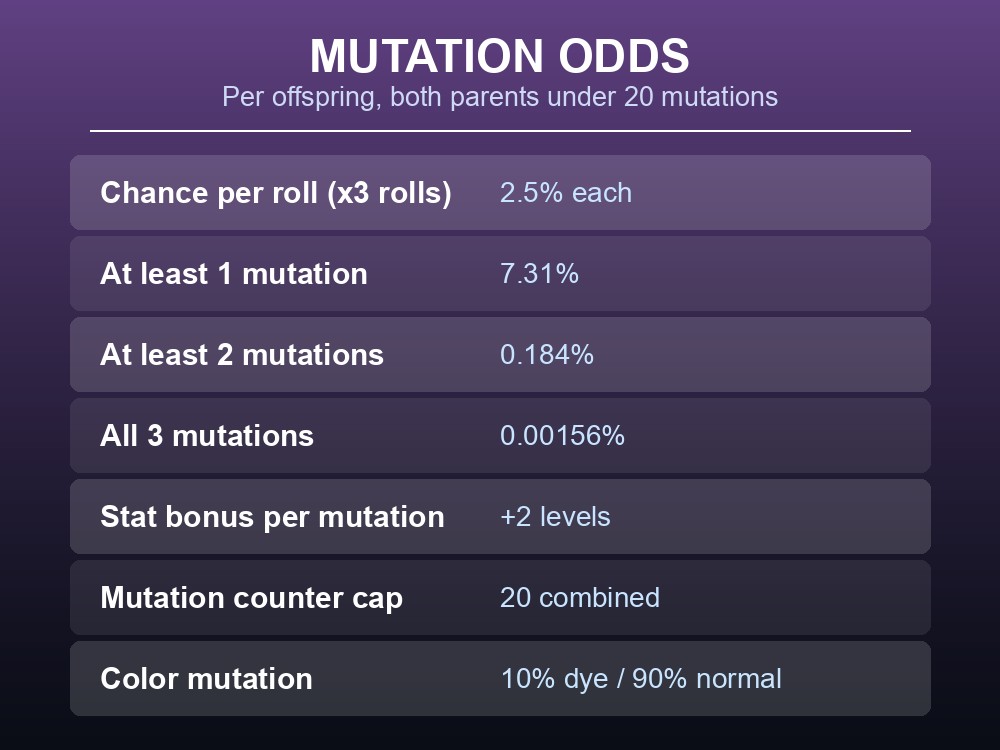
Mutations are where a bred line can exceed both parents' stats. Each offspring gets three independent mutation rolls, and "each mutation iteration has a 2.5% chance to produce a mutation." Naively stacking three 2.5% rolls suggests roughly 7.5% overall — but the real "at least one" probability is a compound calculation, not a sum: 1 − (0.975)³ = 1 − 0.926859 = 0.073141, which matches the source's documented 7.31% exactly. The source also gives the tail: at least two mutations lands at 0.184%, and all three in one offspring is 0.00156%.
Each mutation that lands "adds 2 wild points (levels) to a random stat," and multiple mutations can stack on the same stat — the source notes results like +4 or +6 on one stat from repeated hits. There's a ceiling, though: mutations track on separate paternal and maternal counters shown as X/Y, and "if the combined counters (matrilineal + patrilineal) are greater than 20, any potential mutation automatically fails." At least one parent needs a combined counter under 20 for a roll to be possible — except "a male's counter may exceed 20 as long as you keep breeding it with females whose combined counter is under 20," the standard way breeders keep a high-mutation male line productive past the cap. With a maxed parent the odds shift: 3.337% at-least-one if the stronger parent already has 20+ mutations, 4.07% if it's the weaker parent, 0% if both are past 20. A mutation also rerolls a color region — roughly 10% dye color, 90% normal color.
Imprinting: cuddles, food, and walks
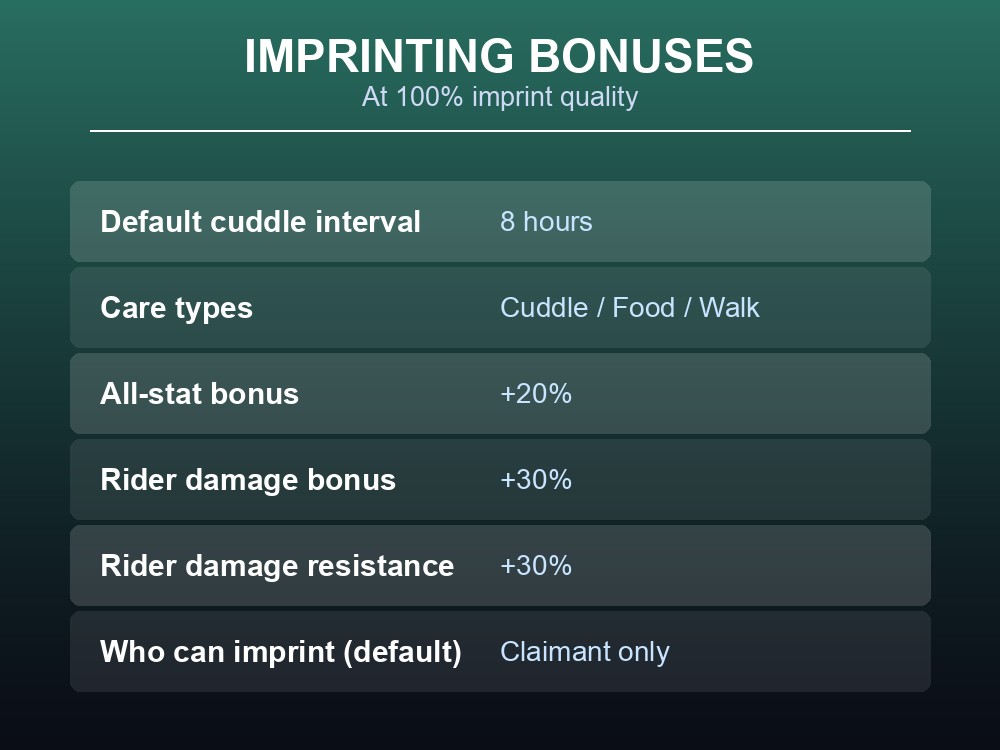
Imprinting needs your active attention after the baby exists. The default "Wants Care In" timer between imprint requests — the cuddle interval — is 8 hours (DCIT = 28800 seconds); the source notes "Patch 275.4" moved this default from 4 hours to 8. Each request is one of three care types: Cuddle (press the use key), Food (place the requested food in the right d-pad slot and press use), or Walk (whistle follow and travel roughly 0–20 foundations from the start location).
Imprint quality builds toward 100% in steps, and the size of each step is species-dependent: the source approximates it as "Imprinting Affinity Gain = 8 Hours / Total Maturation Time of Species," meaning fewer, larger care events are needed on species (or rate settings) with shorter total maturation times. The specific maturation time for any individual species isn't in the sourced data here, so treat that half of the formula as something to check per-creature rather than assume.
The payoff for hitting 100% is concrete: a +20% bonus to all stats — health, damage, speed, and torpor (stamina, oxygen, and crafting skill are excluded) — scaling proportionally below 100%. If you're the one riding a creature you personally imprinted, there's a second bonus on top: +30% damage dealt and +30% damage resistance at 100% imprint, also scaling proportionally below that. By default game config, only the player who claimed the newborn can imprint it — so deciding who claims a baby is also deciding who gets to bank that rider bonus.
Practical checklist: keep at least one parent's combined mutation counter under 20 if you want mutation rolls to still work; don't walk away from a fresh baby — the 8-hour cuddle clock starts immediately and a missed window still costs imprint quality; and remember the rider bonus only applies to the player who actually claimed and imprinted the baby, not whoever's currently sitting in the saddle.
Running your own ARK server
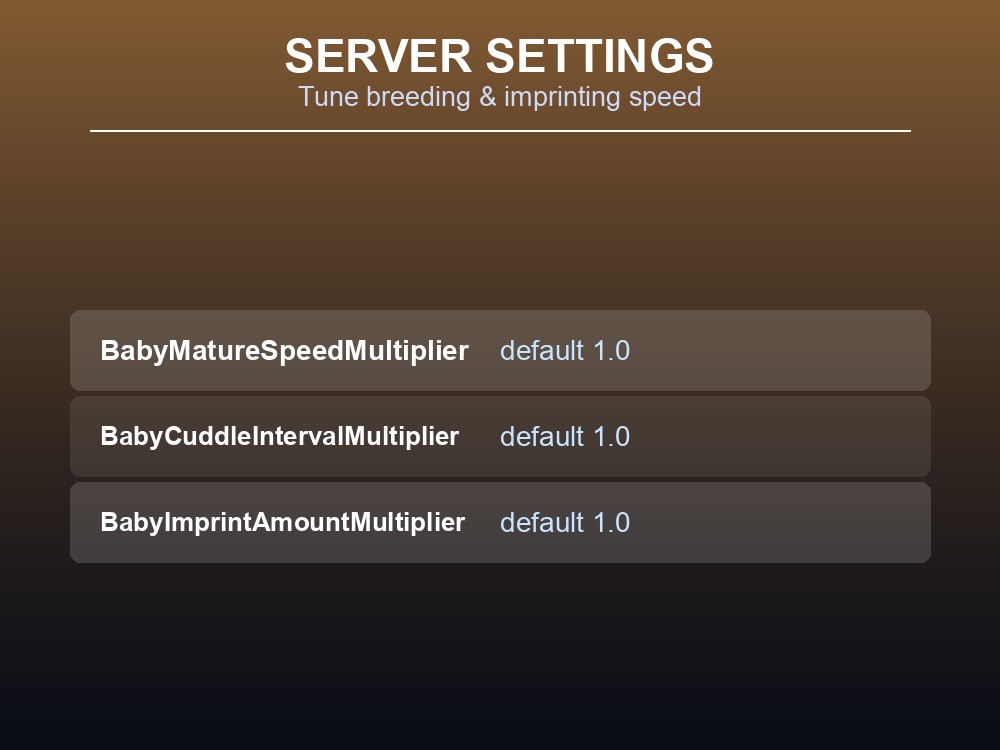
None of the math above is fixed — a server can retune breeding and imprinting pace with three multipliers. BabyMatureSpeedMultiplier (default 1.0) controls how fast babies move through the Baby/Juvenile/Adolescent phases. BabyCuddleIntervalMultiplier (default 1.0) scales the interval between imprint requests, shortening or lengthening the 8-hour default. BabyImprintAmountMultiplier (default 1.0) scales how much imprint quality each care event grants — useful for smaller communities that can't hit every cuddle window at the vanilla rate.
If you're running these settings on your own box, a gamever ARK server gives you full control over that configuration without touching command lines by hand — spin one up, dial in the multipliers that fit your community's pace, and use promo code WELCOME for your first server.
Conclusion
A well-bred ARK creature isn't luck — it's three stacked systems, each with documented odds: a 55% per-stat inheritance roll, three 2.5% mutation rolls that compound to a real 7.31% "at least one" chance, and an imprint routine that's worth a flat +20% to every combat stat (plus +30%/+30% for whoever rides it). Understanding the actual numbers, rather than the rounded folk-math version of them, is what separates a breeding project that pays off from one that quietly falls short of its potential.