
ARK Arat Prime: Environmental Hazards and Features
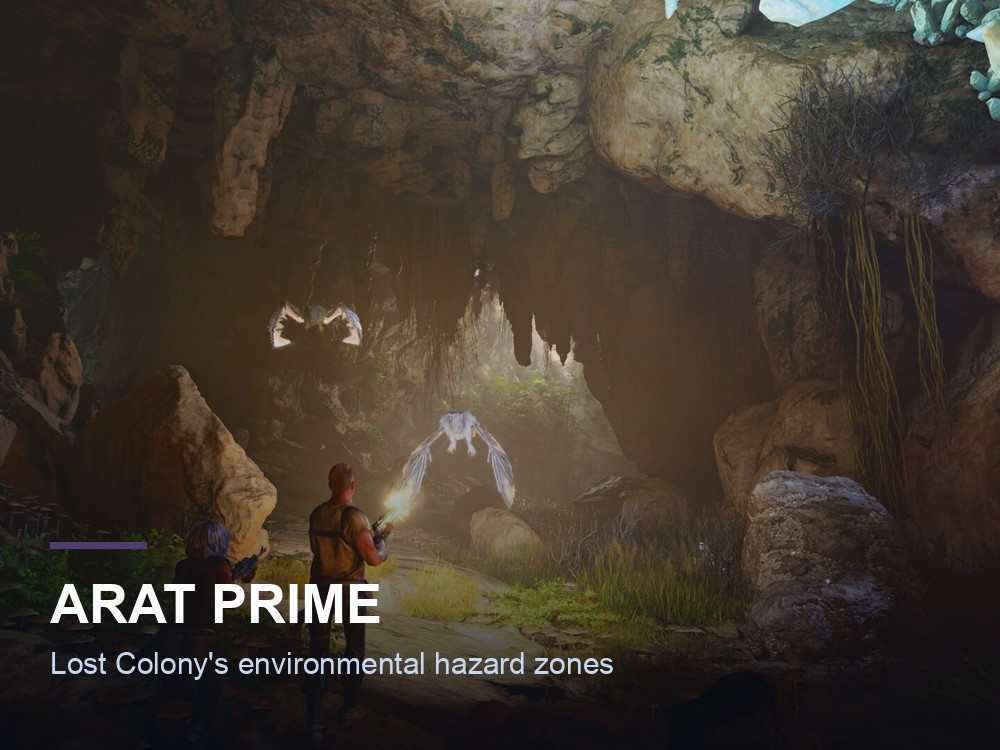
Arat Prime, the setting of the Lost Colony expansion for ARK: Survival Ascended, is not one biome but several stitched together — a gothic city, an arctic wasteland, a bioluminescent forest, and at least two zones the wiki flags as outright dangerous. Per ark.wiki.gg's "Unique environmental features" list for the map, the terrain itself acts as a hazard, separate from the Thralls, Neophytes, and Revenants that also patrol it. This guide sticks to what that features list documents — eight bulleted zones — plus the wiki's Data Maps section for getting around them. Where the source doesn't give a number, this guide says so instead of guessing.
The Gothic Metropolis and Its Volcanic Power Core
The wiki's first documented feature is "a majestic, tiered gothic metropolis, guarded by the Thrall army" — the city anchoring the map and the Lost King's stronghold. What powers it, per the same list, is "a collapsed volcanic crater that serves as the city's power core, where superheated water channels geothermal energy upward, feeding the gothic metropolis with radiant heat." At the crater's center "looms a colossal megalithic ring — a sacred ritual site consecrated by the Lost King," tying the map's geology into its story rather than sitting there as backdrop.
None of that comes with a temperature figure, a heat-damage number, or a documented insulation requirement for the crater — the features list is descriptive, not statistical, so this guide doesn't invent numbers. What it establishes is the hazard's shape: a heat-based zone at the city's core, guarded by a hostile faction, built around a ritual structure rather than a resource node.
Arctic Wastes, Crash Craters, and the Twilight Forest
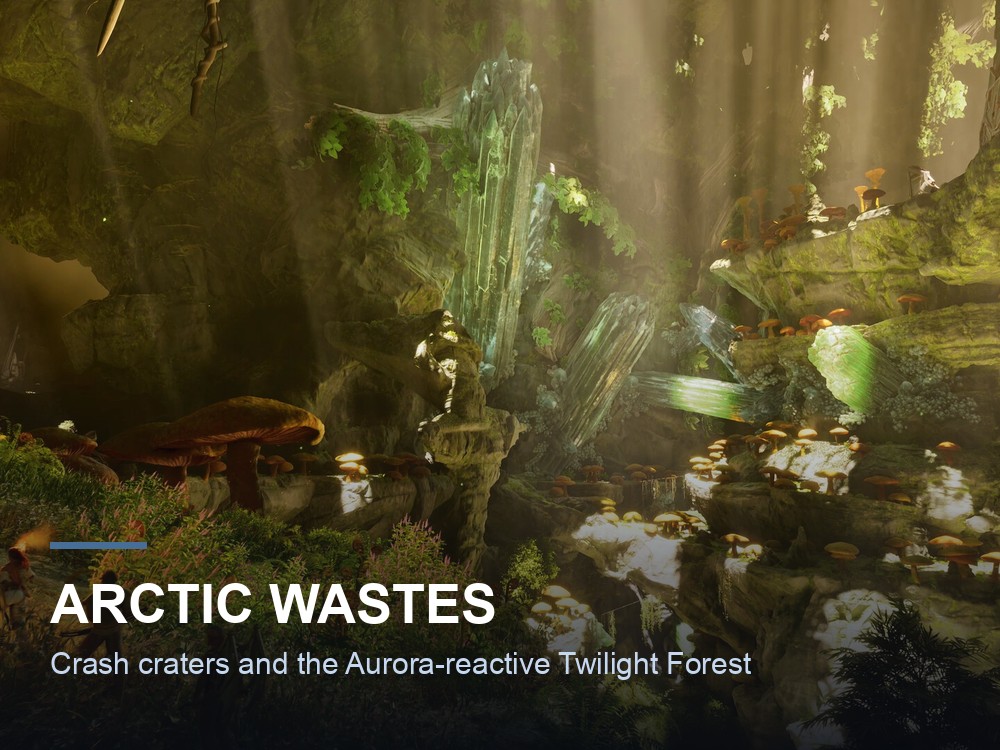
Away from the city, the wiki documents "a desolate Arctic expanse scarred with craters and debris from a large fallen ARK that crashed back to Earth" — the cold zone doubles as a crash site, not just a temperature hazard. The same list adds "craggy peaks and knife-edge rocky spires" as a separate feature, and singles out the Twilight Forest, described as "a fantasy boreal nightmare where the bioluminescent flora reacts dynamically to the Auroras overhead." That's the wiki's own phrasing for plant life that visibly responds to the sky — a mechanic the source names but doesn't quantify (no documented light-radius, damage, or buff/debuff tied to the reaction).
Scattered through this stretch are Hot Springs, called "pockets of geothermal activity" that "provide ample water and resources" — the one feature framed as a benefit rather than a threat. Two fields that would pin all of this to the map are empty in the source: "Regions" and "Approximate spawn locations" carry no content on Arat Prime's wiki page, so this guide can't say exactly where the Arctic expanse ends and the Twilight Forest begins — undocumented, not omitted by choice.
The Twisted Woodland Gateway and the Aberrant Crash Sites
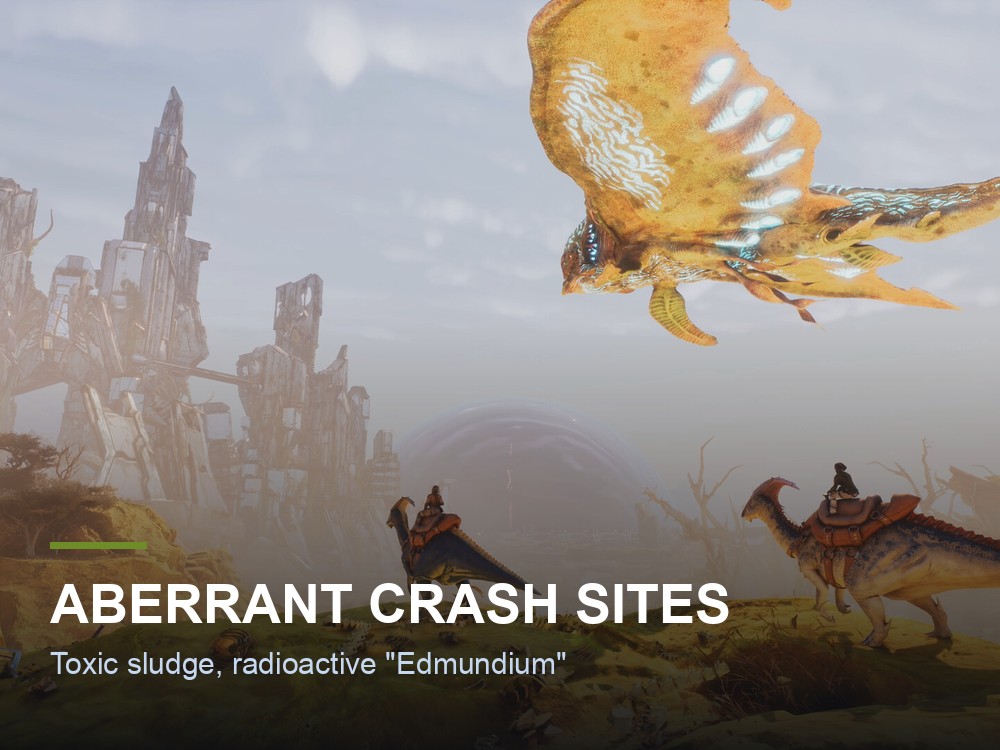
Between the safer zones and the map's worst terrain sits "a twisted, foreboding woodland that serves as the gateway to the map's more dangerous zones" — the wiki's own framing marks this forest as a threshold, not a destination. Past it lies the list's most explicit hazard, quoted exactly as the source writes it: Aberrant Crash Sites are "hazardous, toxic sludge environments where debris from the crashed Aberrant ARK had corrupted the landscape, twisting flora and fauna into radioactive nightmares and bubbling pools of corruptive liquid 'Edmundium.'"
The Lore section corroborates it from the story side: "The landscape is scarred by the crash of the Aberration ARK, resulting in radioactive 'Aberrant Crash Sites' filled with mutated creatures and pools of liquid 'Edmundium.'" Both mentions call the zone radioactive, but neither gives a radiation figure, a damage rate, or a named list of which mutated creatures spawn there. This guide treats that as an open gap rather than assuming the map's Gargoyle roster (below) is the same "mutated creatures" the lore mentions — the source never draws that line itself.
Navigating the Hazards: Data Maps and Gargoyle Statues
For routing around the zones above, the wiki links three navigable maps under its "Data Maps" gallery: one captioned "Strategic Resources" (the Resource Map), one captioned "Exploring the map" (the Explorer Map), and one captioned "Creature Spawns" (the Spawn Map). The captured text names only the three map types and captions, not embedded coordinate data, so treat this as confirmation the tools exist, not a substitute for opening them directly.
One more hazard: Gargoyles. The wiki describes them as "creatures who have been frozen in time by the statue and are awakened when alerted by the Red Colony," adding that "none of the creatures listed here are tamable due to the Lost effect." A motionless statue on Arat Prime isn't necessarily scenery. Counting the wiki's own roster — Argentavis, Arthropluera, Baryonyx, Brontosaurus, Carnotaurus, Ceratosaurus, Chalicotherium, Cryolophosaurus, Deinotherium, Desmodus, Dire Bear, Direwolf, Gigantopithecus, Gigantoraptor, Iguanodon, Kaprosuchus, Malwyn, Mammoth, Managarmr, Megatherium, Ossidon, Pegomastax, Phiomia, Purlovia, Raptor, Rex, Rock Drake, Rock Elemental, Sabertooth, Spino, Stegosaurus, Therizinosaur, Thylacoleo, Woolly Rhino, Yi Ling, and Yutyrannus — comes to 36 species listed as possible Gargoyle forms, none tameable under that effect. The page doesn't say which of the eight zones above each type favors, so this guide doesn't assign one.
Plan a route with the Resource, Explorer, and Spawn maps before committing supplies — the wiki confirms all three exist, even without embedded coordinates here. Treat any unmoving, familiar-looking creature as a possible Gargoyle rather than free loot, since none of the 36 listed species are tamable under the "Lost effect." Expect the Twisted Woodland and Aberrant Crash Sites to be the map's most hostile stretch — toxic sludge and "radioactive nightmares," per the wiki's wording — and don't assume gear numbers the source itself doesn't publish. The volcanic power core's megalithic ring is a "sacred ritual site," not a safe waypoint.
Running your own ARK server
Arat Prime's zones — the Hot Springs' resources, a cleared stretch of the Twisted Woodland, a scouted route past the Aberrant Crash Sites — are easy to lose to a crowded public server, where another tribe can camp a resource pocket or tag a Gargoyle you were tracking first. A private, dedicated ARK server keeps these hazard zones and your progress mapping them on your own schedule, with no competition for the same Hot Spring or ritual-site landmark.
Ready to explore Arat Prime's hazards without racing another tribe for them? Spin up your own ARK server and get in. Use promo code WELCOME for your first month free.
Conclusion
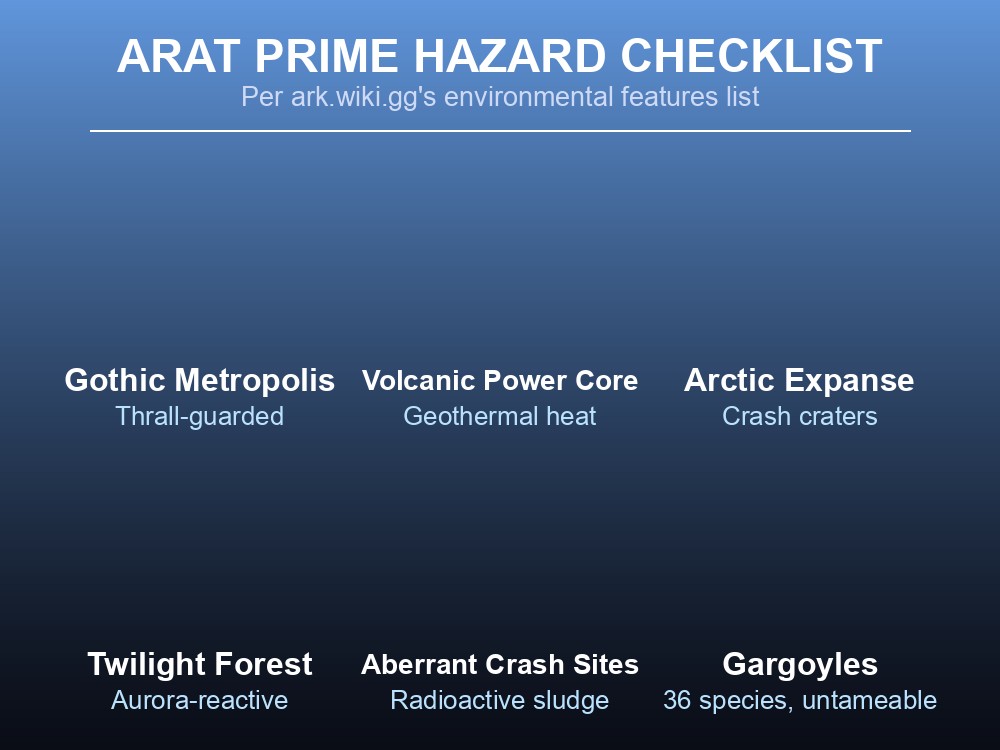
Arat Prime's documented environmental hazards break into eight features on ark.wiki.gg's list: the Thrall-guarded gothic metropolis and its volcanic, geothermal power core with a sacred megalithic ring at its center; a crater-scarred Arctic expanse and craggy rocky spires; the Aurora-reactive Twilight Forest; the resource-friendly Hot Springs; a twisted woodland gateway; and the radioactive, Edmundium-filled Aberrant Crash Sites. Three navigable Data Maps (Resource, Explorer, Spawn) and a 36-species Gargoyle roster of statues that "awaken" round out what the wiki documents for getting around safely. What it doesn't document — exact temperatures, damage rates, coordinates, or which creatures specifically populate the Aberrant Crash Sites — is flagged above as a gap, not filled in with a guess.